
The Property Damage Gap
Why Personal Injury Lawyers Skip the Car Repair Claim — and What That Costs Auto Accident Victims
After a car accident you have two separate claims: bodily injury and property damage. Most personal injury lawyers only handle the first. This research note explains why, what it leaves victims exposed to, and the concrete playbook for getting paid on the property damage side without one.
A research note from AskMatlock — May 2026.
When you hire a personal injury lawyer after a car accident, most people assume one thing: the lawyer is going to handle everything. The medical bills. The insurance fight. And the car.
That assumption is wrong on the third part. And almost nobody finds out until the body shop calls.
Key findings
- Personal injury lawyers in the United States almost universally decline to handle the property damage portion of an auto accident claim. The practice is openly explained by PI firms themselves as a function of contingency-fee economics — and is ethically permitted under ABA Model Rule 1.2(c) and state bar opinions such as NC State Bar RPC 240 (1997).
[ABA-MR-1.2][NC-RPC-240]- Every auto accident produces two parallel claims. A bodily injury claim that takes months or years and is what your PI lawyer signs up for, and a property damage claim that resolves in days or weeks and is yours to handle alone. The two are usually handled by two different adjusters at the same insurance company.
- The contingency math doesn't work on property damage. An average repairable claim settles for roughly $4,500; a total loss for $10,000–$12,000. A one-third contingency yields $1,500–$3,300 in fees against the same procedural overhead as a small bodily injury claim.
[NAIC-AIDB-2025]- The property damage claim contains seven distinct sub-disputes: repair vs. total loss, actual cash value (ACV), diminished value, rental coverage, storage and towing, personal property, and betterment deductions. Each has its own insurer playbook.
- In May 2024, the Alameda County District Attorney sued USAA, Progressive, CCC, and Mitchell alleging that total-loss valuation software systematically underpays claims by $3,000–$4,000 per claim, with statewide underpayment "likely in the billions."
[CADA-Alameda-2024]- Of the 50 states, only Nebraska does not recognize third-party diminished value claims at all. Georgia is the consumer-friendly outlier — Mabry v. State Farm (2001) requires insurers to proactively evaluate first-party diminished value, the only such mandate in the country.
[MWL-50State-DV][Mabry-2001]- The implication. Even the 52% of bodily injury claimants who retain counsel are typically unrepresented on property damage. The property damage representation gap applies to nearly the entire claimant population — far broader in scope than the 600,000-person bodily injury gap documented in AskMatlock's prior research.
[AskMatlock-15B-2026]- You can handle this yourself. §7 of this note is a concrete, step-by-step playbook for each of the seven sub-claims — what to do, in what order, with what leverage, and when to escalate.
Table of contents
Total reading time: approximately 13 minutes end-to-end. Section reading times in parentheses.
- §1 — Two claims, one accident (1 min)
- §2 — Why lawyers skip the property damage claim (1 min)
- §3 — The seven things you have to handle yourself (2 min)
- §4 — State variation worth knowing (1 min)
- §5 — The Alameda County case (1 min)
- §6 — Who can actually help (1 min)
- §7 — The playbook: how to actually get the money (5 min)
- §8 — Closing thoughts (1 min)
- §9 — Sources and citations (skim)
§1. Two claims, one accident
Every auto accident produces two parallel insurance processes that move at different speeds and through different desks.
The bodily injury claim is a tort claim against the at-fault driver's insurer for your injuries. It's worth thousands to hundreds of thousands of dollars. It takes months or years to settle. It involves medical records, expert testimony, lien resolution, and a real legal fight. This is what your PI lawyer signs up for.
The property damage claim is a separate, mostly bureaucratic process that resolves in days or weeks. It involves your repair shop, an insurance adjuster, and a settlement number — either for repairs or for the actual cash value of the car if it's totaled. There's no lawsuit. There's rarely a lawyer.
These two claims are usually handled by two different adjusters at the same insurance company, working under different rules, with different deadlines, and with different leverage points. Your PI lawyer is hired to fight the first one. The second one is yours.
This split is not an accident of the system — it is a structural consequence of how plaintiff-side legal services are financed in the United States, documented in PI firms' own client-facing FAQs and authorized by bar opinions in multiple states. [Dolman-2022] [MillerZois-2024] [NC-RPC-240]
§2. Why lawyers skip the property damage claim
The reason is straightforward: the contingency-fee math doesn't work.
Personal injury lawyers earn their fee as a percentage of the settlement — usually one-third of the recovery before a lawsuit is filed, 40% if a suit is filed. That model works on a serious bodily injury claim, where the gross settlement averages around $80,000 and the lawyer's effective hourly rate over 40–80 hours of work lands in the several-hundred-dollars-an-hour range. [AskMatlock-15B-2026]
On a property damage claim, the math collapses.
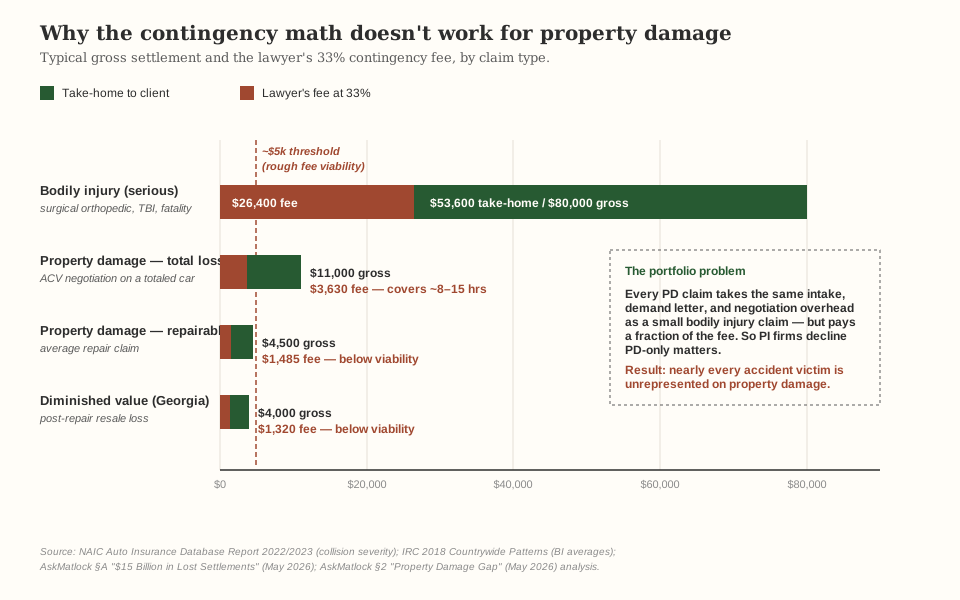 Figure 1: Typical gross settlement and the lawyer's contingency fee at 33% for each claim type. The bodily-injury fee covers 40–80 hours of attorney work at sustainable rates; the property-damage fees do not cover the procedural overhead of working the case. Sources: NAIC AIDB 2022/2023 collision severity, IRC 2018 Countrywide Patterns BI averages, derived from §A of the AskMatlock $15B research note.
The unpaid-work problem is the binding constraint. Every property damage claim requires the same procedural overhead as a small bodily injury claim — intake interview, demand letter, ACV documentation, comparable-vehicle research, paperwork — but produces a fraction of the fee. PI firms run their portfolio the way every contingency business runs: they take the cases where the math works and pass on the ones where it doesn't.
Several large PI firms say this openly. Dolman Law Group in Florida tells prospective clients that property damage cases "do not often result in significant financial recovery" and so "it is usually not worth it for the personal injury attorney to take on these cases." [Dolman-2022] Miller & Zois in Maryland says it "does not take a contingency fee for property damage." [MillerZois-2024] Sullivan Papain in New York, Batta Fulkerson in California, and dozens of other firms publish substantially the same FAQ on their websites. [SullivanPapain] [BattaFulkerson]
This is, in a rare instance, an industry being transparent about not serving a customer segment. The transparency does not change the outcome: you are on your own for the car.
§3. The seven things you have to handle yourself
The property damage claim is not a single conversation. It's a sequence of sub-claims, each with its own insurer playbook and its own opportunity for the victim to leave money on the table.
1. Repair vs. total loss. The insurer decides whether to fix the vehicle or declare it a total loss, usually based on a state-set threshold — typically 70–80% of actual cash value. The decision is the insurer's, not yours, and it's calculated using estimates the adjuster controls.
2. Actual cash value (ACV). If the car is totaled, the insurer offers what it calls "actual cash value" — replacement cost minus depreciation. The number comes from proprietary software like CCC ONE, Mitchell, and Audatex, which selects "comparable" vehicles from outside the local market and applies "condition adjustments" the consumer cannot audit. ACV offers are typically negotiable. Most owners do not know that.
3. Diminished value (DV). Even when a vehicle is repaired to perfect condition, its resale value drops because Carfax and AutoCheck records show the accident. That loss is real and, in most states, collectable from the at-fault driver's insurer. Of the 50 states, only Nebraska does not recognize third-party diminished value claims at all. [MWL-50State-DV] The dominant valuation method — the "17c formula" — originated in the Mabry v. State Farm settlement (Ga. 2001) and produces, by design, the lowest of the recognized DV calculation methods. [Mabry-2001]
4. Rental car coverage. You're entitled to a rental while the vehicle is repaired or replaced — but the insurer controls the rental class, the duration, and when it cuts the rental off. Adjusters routinely end rentals before total-loss checks are issued, leaving the victim driving on their own dime.
5. Storage and towing fees. If the vehicle sits at a body shop or tow lot, those fees accumulate daily. The insurer may refuse to pay past a "reasonable period" it defines unilaterally. The victim can end up with a lien on a car that's not theirs anymore.
6. Personal property inside the vehicle. Car seats, tools, aftermarket equipment — the insurer typically pushes these claims to the victim's homeowner's or renter's policy, where the deductible often exceeds the loss.
7. Betterment deductions. When the insurer pays to replace a worn part (tires, battery, exhaust) with a new one, it may deduct "betterment" on the theory that the owner received an upgrade. The deduction is often negotiable. Most people accept it without asking.
Each is a small fight. Combined, they decide whether the settlement leaves the victim whole or several thousand dollars short of where they should be. §7 of this note is the playbook for each.
§4. State variation worth knowing
Property damage rules vary more than most consumers realize.
- Georgia. The 2001 Georgia Supreme Court decision in Mabry v. State Farm forced insurers to proactively evaluate first-party diminished value claims — no other state requires this. A small industry of specialist firms exists in Georgia specifically because owners actually get paid for DV there.
[Mabry-2001] - Nebraska. The only state that does not recognize third-party diminished value claims.
[MWL-50State-DV] - Michigan. Caps third-party property damage recovery at $3,000 under the state's mini-tort statute — one of the most consumer-unfriendly states for property damage.
- Louisiana. A one-year prescriptive period — the shortest in the country — meaning property damage claims expire faster there than anywhere else.
- Washington. The most prescriptive total-loss handling rules in the country, with administrative regulations (WAC 284-30-391) spelling out comparable-vehicle methodology in detail.
If a victim doesn't know which side of these lines their state sits on, the insurer absolutely does.
§5. The Alameda County case
In May 2024, the District Attorney of Alameda County, California, filed suit against USAA, Progressive, CCC Intelligent Solutions, and Mitchell International — the two largest auto carriers and the two dominant total-loss valuation software vendors. [CADA-Alameda-2024]
The complaint alleges that the valuation software systematically underpays totaled-vehicle claims by $3,000 to $4,000 per claim, and that statewide underpayment is "likely in the billions of dollars."
This is an allegation, not a court finding, and the case is ongoing. But it's a useful data point because it's a public-record number from a prosecutor's office — not a marketing claim. The order of magnitude lines up with what specialist appraisers have argued for years: the software is tuned to produce low offers, and unrepresented owners accept them because they have no way to evaluate the math.
If even half of the alleged shortfall is real, total-loss owners across the country are leaving billions on the table every year — far more than the rounding-error figure most people assume property damage to be.
§6. Who can actually help
You cannot hire a PI lawyer for property damage. But you have options.
- Diminished value specialists issue independent appraisal reports (typically $150–$500) and, in some states, file the claim on the owner's behalf.
- Total-loss appraisers are used to invoke the appraisal clause in the insurance policy — a contractual right most owners don't know exists. When the owner and the insurer disagree on ACV, each side hires an appraiser, and a neutral umpire decides the number. Specialist firms charge a flat fee.
- Public adjusters can represent the policyholder in first-party (collision and comprehensive) claims against their own insurer. They typically charge 5–20% of recovery, regulated by state. They generally cannot handle third-party claims against the at-fault driver's insurer — a structural gap in the system.
- State Department of Insurance complaints are free. Most state DOIs resolve a majority of consumer complaints in the consumer's favor. Auto insurance complaints to state DOIs rose approximately 32% from 2021 to 2024.
[ValuePenguin-DOI-2024] - Small claims court is available in most states for property damage disputes up to $5,000–$25,000, depending on the jurisdiction. No lawyer required.
The structural insight: the system of help for property damage is real, but it's fragmented across specialists most people don't know how to find. There is no single branded channel — no "Morgan & Morgan for fender-benders" — because the economics don't support one.
§7. The playbook: how to actually get the money
This section is the practical playbook for each of the seven sub-claims: what to do, in what order, and what leverage to use. Nothing here is legal advice. It is documented practice — drawn from state insurance regulator guidance, public adjuster trade literature, and the property-damage handling rules published by state DOIs.
§7.1. Five universal rules — before anything else
These apply to every sub-claim. They are the difference between negotiating from a position of evidence and negotiating from a position of memory.
- Get everything in writing. Verbal commitments from adjusters are not enforceable. Every offer, every promise, every deadline — email it back to the adjuster the same day to create a paper trail. "Confirming our call of today: you committed to X by Y." If they don't correct it, it's the record.
- Record phone calls where legal. Thirty-eight US states are one-party consent — you can record without telling the adjuster. Twelve states are two-party consent (CA, CT, DE, FL, IL, MD, MA, MT, NV, NH, PA, WA) and you have to inform them. Look up your state before you start. The recording is your protection against adjusters who change their position between calls.
- Never sign a release without reading it carefully. A signed release closes that claim forever. Releases sometimes try to close more than they should — read every line, and ideally have someone else read it too. If the release language covers "all claims arising from the accident" and you have an ongoing bodily injury claim, do not sign.
- Document the loss day one. Photos of the vehicle from every angle, the interior, the odometer reading, the damage in detail, the engine bay. The day the vehicle leaves your possession is the day you stop being able to add evidence.
- Track every cost. Storage fees, towing, rental, transportation to and from the body shop, time off work to deal with the claim. You can claim what you can document — the line items add up.
§7.2. Total loss and Actual Cash Value (ACV) — the highest-value negotiation
The single most valuable negotiation in a property damage claim is the ACV number on a totaled vehicle. The Alameda County DA alleged in May 2024 that valuation software underpays this number by $3,000–$4,000 per claim. Here is how to push back.
Step 1: Get the insurer's valuation report. It will typically be a CCC ONE, Mitchell, or Audatex report. Request it in writing. The carrier is required to provide it in most states.
Step 2: Pull your own comparables. Use Kelley Blue Book (kbb.com), NADA Guides (nadaguides.com), Edmunds (edmunds.com), Cars.com, AutoTrader, and CarGurus. Search within your local market — typically within 50–100 miles of your home ZIP. Look for vehicles of the same year, make, model, trim, mileage range, and condition. Save each listing as a PDF. Those listings are your evidence.
Step 3: Audit the "condition adjustments" line by line. The insurer's valuation will deduct dollars for "below average condition" or "high mileage" or "missing options." Each adjustment should be itemized. Challenge any you disagree with and provide your own documentation (service records, photos showing the condition).
Step 4: Add what they missed. Aftermarket equipment, recent maintenance (new tires, brakes, battery, timing belt), low mileage relative to similar vehicles, special trim, towing package — every one of these should add to the ACV. Pull receipts and document.
Step 5: Make a written counter-offer. Cite your comparables. Cite your audit. Demand a revised valuation in writing within a specific window (10–14 days is standard).
Step 6: If they refuse to move, invoke the appraisal clause. See §7.3.
A negotiated ACV increase of even 10% on a $15,000 vehicle is $1,500 in your pocket for an afternoon of work. On a $40,000 vehicle, 10% is $4,000.
§7.3. The appraisal clause — the most underused tool in your policy
Almost every auto policy contains an appraisal clause that binds the insurer to a neutral valuation process when you and they disagree on ACV. Most policyholders don't know it exists.
How it works:
- Find the clause in your policy. Search for "appraisal" in the policy PDF. It's almost always in the conditions section.
- Send written demand invoking the appraisal clause. The exact required language is in the policy itself.
- Each side appoints an appraiser within a short window (typically 20 days).
- The two appraisers jointly select an umpire (a neutral third party — typically a licensed appraiser or sometimes a retired judge).
- They evaluate the vehicle and submit valuations. When two of the three agree on a number, that valuation is binding on both sides.
Costs: typically $300–$800 for your appraiser, plus your share of the umpire's fee (split 50/50 by policy). Specialist firms exist nationally — search "[your state] auto appraisal clause" or "total loss appraiser [your state]" — and most charge a flat fee.
When it makes sense: any time the gap between the insurer's offer and your evidence-based number is greater than $1,500–$2,000. Below that threshold, the appraiser fees eat the upside; above it, you're typically money ahead.
§7.4. Diminished value (DV) — the claim most people never file
If your vehicle is repaired (not totaled), and you live in any state except Nebraska, you may be entitled to diminished value compensation — the loss in resale value the accident creates even after perfect repair.
Step 1: Check your state's rules. The Matthiesen, Wickert & Lehrer 50-state survey is the most comprehensive reference. [MWL-50State-DV] Some states recognize only third-party DV (against the at-fault driver's insurer); Georgia is the only state that requires first-party DV evaluation proactively. Most states sit between.
Step 2: Get an independent DV appraisal. Specialist firms charge $150–$500 for a written DV report based on actual market comparables. Search "[your state] diminished value appraisal." A few national firms: Diminished Value of Georgia, Auto Value Professionals, DVUSA, Wreck Check.
Step 3: Use the 17c formula as the floor, not the ceiling. Insurers default to the 17c formula because it produces, by design, the lowest of the recognized DV calculation methods (it caps base value at $10,000, applies a 10% damage multiplier, and reduces by mileage). An independent appraiser using market-based methods often arrives at a substantially higher figure.
Step 4: Submit a written DV demand within your state's statute of limitations. Statutes vary from one year (Louisiana) to four years (Georgia, Nebraska). File early.
Step 5: If denied, escalate. A DV claim that the insurer refuses to pay is appropriate for small claims court in most states, since DV awards typically fall within small-claims dollar limits.
§7.5. Rental car coverage
Most policies cover a rental while your vehicle is being repaired or replaced. The insurer controls what they pay for, but each control point is negotiable.
- Get written confirmation upfront of (a) the class of rental, (b) the daily rate cap, and (c) the maximum number of days. Email back the same day.
- Match your vehicle class. If you drive an SUV, you're entitled to an SUV-class rental — not a compact. Insurers default to the cheapest class unless you push back.
- Track repair delays and document the cause. If the body shop is waiting on parts, or if the insurer is delaying authorization, each day of delay caused by the insurer is a day they should keep paying for. Get the body shop to put delays in writing.
- Negotiate extensions in writing. Do not accept "we'll see how it goes" — get a written commitment to extend the rental until repairs are complete or the total-loss check is issued.
- For total loss: rental continues until the check arrives, not until the insurer declares total loss. Many adjusters cut rentals at the declaration date. Push back.
§7.6. Storage and towing fees
These pile up daily. The insurer will pay only what they consider "reasonable" — and "reasonable" is whatever they decide.
- Move the vehicle out of storage ASAP. Tow yards routinely charge $50–$150 per day in storage. Move the vehicle to a no-fee location (your driveway, a friend's garage) the moment it's safe to do so.
- Get written commitment from the insurer to cover storage through a specific date before fees accrue beyond that date.
- Keep every invoice. If the insurer later disputes a fee, your receipts are the evidence. Without them, you're arguing from memory.
- For total-loss vehicles: the insurer's responsibility for storage typically ends when the salvage title is transferred. Push to transfer quickly to stop the meter.
§7.7. Personal property inside the vehicle
The car seat. The tools in the trunk. The aftermarket stereo. The laptop in the backseat. The work equipment.
- Photo inventory immediately. If you can, before the vehicle is towed. After, the chance to add items to the claim shrinks fast.
- Pull receipts for high-value items — anything over $200 or so.
- Submit a written demand to the auto insurer first. The insurer will try to push you to your homeowner's or renter's policy, because those policies often have a $500–$1,000 deductible that wipes out the claim. Push back — the auto policy should cover items lost or damaged in the vehicle, subject to the policy's personal effects coverage limits.
- Document the loss. Stolen-from-vehicle vs. damaged-in-crash matters for coverage analysis. Be specific.
§7.8. Betterment deductions
When the insurer pays to replace a worn part (tires, battery, exhaust system, sometimes paint) with a new one, it may deduct "betterment" on the theory that you received an upgrade.
- Always ask why and how much. Get the deduction in writing with a specific calculation. "Standard betterment" is not a calculation.
- Question the percentage. Many betterment deductions are based on rule-of-thumb percentages the body shop and insurer customarily use. They are often negotiable.
- Refuse on the principle. If the part was functional at the time of the accident, the replacement is not an upgrade — it's restoration. Many adjusters will drop the deduction when challenged.
- The body shop knows the customary range. Ask them what betterment they have seen waived on similar claims.
§7.9. The escalation ladder
If the insurer will not move on any of the above, here is the order of escalation, cheapest to most expensive.
- Written demand letter. Restate your numbers, cite your comparables, give a deadline. Send by certified mail with return receipt.
- State Department of Insurance complaint. Free, usually online. The insurer has 15–30 days to respond in writing to the DOI, and most state DOIs resolve a majority of consumer complaints in the consumer's favor.
[ValuePenguin-DOI-2024] - Small claims court. Most states allow property damage claims up to $5,000–$25,000 in small claims, with no lawyer required. Filing fees are typically $50–$100. The judge will resolve disputed ACV, DV, and storage claims quickly.
- Public adjuster. For first-party (collision and comprehensive) claims against your own insurer. Typically 5–20% of recovery, regulated by state. Best for larger claims where the dispute exceeds small-claims jurisdiction.
- Consumer attorney or bad-faith attorney. For large disputes, pattern bad-faith behavior, or cases where the insurer's denial appears to be in clear violation of state insurance law. Typically hourly or contingency on the bad-faith cause of action.
Most disputes resolve at step 1 or step 2. Steps 3–5 exist for the cases that don't.
§8. Closing thoughts
The auto accident system is built around two claims that move on different tracks. Your lawyer is paid to fight one of them. The other one is yours to fight — or yours to lose.
The arithmetic of the property damage gap is straightforward: the contingency model that makes bodily injury representation accessible does not work at property damage dollar amounts. PI firms are honest about this, in their FAQs and their retainer agreements. The fact that the disclosure happens during the most stressful week of a victim's life — with a totaled car, a body shop calling, and an adjuster's voicemail waiting — is what makes the gap structurally costly.
The good news: most of the value can be recovered with the playbook in §7. The ACV negotiation, the appraisal clause, the diminished value claim, the DOI complaint, the small claims filing — none of these require a law degree. They require time, documentation, and the knowledge that the tools exist.
If you're not sure where your case sits, a free AskMatlock case review can help triage whether you have a bodily injury claim worth representing, what your property damage exposure looks like in your state, and which specialist channels to pursue next. It costs nothing and takes about five minutes.
§9. Sources and citations
Bar opinions and ethics rules
[ABA-MR-1.2]American Bar Association, Model Rule of Professional Conduct 1.2: Scope of Representation. https://www.americanbar.org/groups/professional_responsibility/publications/model_rules_of_professional_conduct/rule_1_2_scope_of_representation_allocation_of_authority_between_client_lawyer/[NC-RPC-240]North Carolina State Bar, RPC 240 (adopted January 24, 1997). https://www.ncbar.gov/for-lawyers/ethics/adopted-opinions/rpc-240
Case law
[Mabry-2001]State Farm Mut. Auto. Ins. Co. v. Mabry, Supreme Court of Georgia (2001). https://law.justia.com/cases/georgia/supreme-court/2001/s01a0982-1.html[CADA-Alameda-2024]Alameda County (CA) District Attorney v. USAA, Progressive, CCC Intelligent Solutions, and Mitchell International (filed May 2024). Reported in Repairer Driven News, May 14, 2024. https://www.repairerdrivennews.com/2024/05/14/california-da-sues-insurers-estimating-system-providers-over-alleged-lowball-total-loss-payouts/
Industry and government data
[NAIC-AIDB-2025]National Association of Insurance Commissioners, Auto Insurance Database Report 2022/2023 (released February 2026). https://content.naic.org/sites/default/files/publication-aut-pb-auto-insurance-database.pdf[ValuePenguin-DOI-2024]ValuePenguin, Most Common Insurance Complaints. https://www.valuepenguin.com/most-common-insurance-complaints
Diminished value state survey
[MWL-50State-DV]Matthiesen, Wickert & Lehrer, S.C., Diminution in Value in All 50 States (50-state survey). https://www.mwl-law.com/wp-content/uploads/2018/02/DIMINUTION-IN-VALUE-IN-ALL-50-STATES.pdf
PI firm primary-source statements declining property damage matters
[Dolman-2022]Dolman Law Group, Property Damage-Only Cases in Car Accident Cases. https://www.dolmanlaw.com/blog/property-damage-only-cases-in-car-accident-cases/[MillerZois-2024]Miller & Zois, Property Damage Claims. https://www.millerandzois.com/car-accidents/property-damage-claims/[SullivanPapain]Sullivan Papain Block McGrath Coffinas & Cannavo, Will My Personal Injury Lawyer Handle My Property Damage Claim? https://www.triallaw1.com/will-my-personal-injury-lawyer-handle-my-property-damage-claim/[BattaFulkerson]Batta Fulkerson Law Group, Will a Personal Injury Lawyer Handle a Property Damage Claim? https://battafulkerson.com/will-personal-injury-lawyer-handle-property-damage-claim/
AskMatlock internal research
[AskMatlock-15B-2026]AskMatlock, $15 Billion in Lost Settlements: Why 600,000 Seriously Injured Americans Who Didn't Hire a Lawyer Lost Money They Were Owed (2020–2024) (May 2026). https://askmatlock.com/research/serious-injury-representation-gap
Disclosures
This research note is published by AskMatlock, an AI-powered platform that connects auto accident victims with personal injury attorneys. AskMatlock is not a law firm and does not provide legal advice or legal representation. Nothing in this note creates an attorney-client relationship. The playbook in §7 is documented practice drawn from public regulator guidance and trade literature; it is not a substitute for advice from a licensed attorney in your state.
The claims and figures in this note are sourced and cited above. Where a figure is an allegation rather than a court finding (notably the Alameda County DA's $3,000–$4,000 per-claim figure), it is labeled as such in the body of the note. Where a figure is derived from primary data rather than directly published, the derivation is described in the section that uses it.
This is a research note, not a peer-reviewed study. Comments, corrections, and additional sources are welcome at [email protected].