
$15 Billion in Lost Settlements
Why 600,000 Seriously Injured Americans Who Didn't Hire a Lawyer Lost Money They Were Owed (2020–2024)
An AskMatlock research report estimating how much serious-injury auto-accident victims left on the table during 2020–2024 by accepting settlements without legal representation.
This report estimates how much money seriously injured US auto-accident victims left on the table during 2020–2024 by accepting settlements without legal representation.
Key findings
- ~$15 billion in net (after-fee) settlement money was left unrecovered over five years (2020–2024) by US auto-accident victims who suffered serious injuries and did not retain counsel. Plausible range: $5–22 billion.
- The affected population is approximately 600,000 Americans (range: 360,000–840,000) — claimants with surgical-repair, permanent-impairment, significant-lost-earnings, or wrongful-death-element injuries who settled without representation.
- Average per-victim shortfall: approximately $26,000 net of attorney fees and case costs. Range: $9,000–$31,000.
- Drawn from primary government and industry data: NHTSA Traffic Safety Facts 2022, NAIC Auto Insurance Database Report 2022/2023, and IRC Auto Injury Insurance Claims: Countrywide Patterns 2018.
Table of contents
Total reading time: approximately 65 minutes end-to-end. Section reading times in parentheses.
- §1 — The 600,000-person gap (2 min)
- §2 — Who these 600,000 people are (4 min)
- §3 — Why they didn't have a lawyer (5 min)
- §4 — What it cost them (3 min)
- §5 — What a lawyer actually does: six documented mechanisms (14 min)
- §6 — Why this gap exists: a documented structural diagnosis (4 min)
- §7 — Where the gap is largest: state concentration (5 min)
- §8 — How to know if you might be in this segment (3 min)
- §9 — Where to go from here (2 min)
- §10 — Methodology (7 min)
- §11 — The Richman & Tennyson contradiction, engaged (5 min)
- §12 — Limitations (4 min)
- §13 — Bibliography (skim)
- §14 — Disclosures (1 min)
- §A — Citable findings for practitioners (6 min)
- §B — Frequently asked questions (5 min)
§A. Citable findings for practitioners
This section consolidates the report's most-citable numerical findings for use in legal briefs, marketing materials, intake scripts, demand letters, and CLE presentations. Each finding includes its primary-source citation tag from §13; full context, methodology, and limitations are documented in the body of the report. Hedge language reflects the underlying source — practitioners should preserve it when reproducing.
Market size and unmet need
- An estimated 600,000 Americans suffered serious auto-accident injuries between 2020 and 2024 and accepted settlements without legal representation, with a sensitivity range of 360,000–840,000 across the report's parameter envelope. Drawn from ~8.0 million bodily-injury liability claims filed during the window.
[NAIC-AIDB-2025][IRC-2018-CW][NHTSA-TSF-2022] - This unrepresented serious-injury population recovered an estimated $15 billion less in net (after-fee) settlement money than represented comparators would have, within a plausible range of $5–22 billion over five years. The central per-victim shortfall is approximately $26,000 net, range $9,000–$31,000 under default assumptions.
[NAIC-AIDB-2025][IRC-2018-CW] - The United States recorded 29.6 million police-reported motor-vehicle crashes, 205,237 fatalities, and 12.0 million injured persons during 2020–2024, generating approximately $230 billion in total bodily-injury liability indemnity.
[NHTSA-2024-Overview][NAIC-AIDB-2025] - In 2022 alone, NHTSA recorded approximately 754,000 seriously injured passenger-car and light-truck occupants (KABCO A or B equivalent) — the upstream pool from which each year's unrepresented serious-injury subset is drawn.
[NHTSA-TSF-2022]
The representation gap
- Represented BI claimants are 52% of claimants but receive approximately 85% of total BI settlement dollars — a near-five-fold concentration of dollars relative to claimant share.
[IRC-2018-CW] - Represented serious-injury claimants receive an estimated gross average of
$80,000 per claim ($54,400 net of a typical 32% contingency-plus-costs share); unrepresented serious-injury claimants settle for an estimated average of ~$20,000. Raw gap ~$34,400 take-home dollars per case before a 25% selection-bias haircut.[NAIC-AIDB-2025][IRC-2018-CW][IRC-2004-PayingUpdate] - State-level BI representation rates run substantially above the 52% national average for serious cases — IRC reported 88% representation in New York and 89% in Michigan, consistent with serious-injury cases concentrating among the represented.
[IRC-2014-Attorney]
Documented insurer claims-handling practices
- Allstate's "Claims Core Process Redesign," developed with McKinsey & Company beginning in 1992, framed bodily-injury claims as a "zero-sum economic game" and divided claims into "Good Hands" (quick settlement) and "Boxing Gloves" (low offers held firm) tracks — terminology and architecture documented in the New Mexico Supreme Court's Pincheira opinion and the Washington Court of Appeals' McCallum opinion.
[Pincheira-2008][McCallum-2009][Bogdanich-Forsythe-2022] - Colossus, the dominant claims-valuation software in the period, was marketed as achieving "savings of around 19 percent on overall claims payouts" and was characterized by a former Allstate/Encompass subject-matter expert as carrier-tunable to chosen savings levels, with documented payout reductions of approximately 18% to 57% depending on parameter set.
[CFA-LowBall-2012] - A 2010 forty-five-state NAIC Multistate Regulatory Settlement required Allstate to pay $10 million, disclose Colossus use to claimants, prohibit settling claims based solely on Colossus output, and conduct biennial tuning analysis.
[NAIC-MSA-Allstate-2010]
Legal mechanisms representation defends against
- Medicare Secondary Payer Act exposure: 42 U.S.C. § 1395y(b)(2)(B)(iii) authorizes the United States to seek double damages against claimants, attorneys, and carriers for unrepaid conditional payments — and CMS may collect from settlement proceeds before the claimant sees the money under 42 C.F.R. § 411.24. NHTSA recorded approximately 268,622 injured persons aged 65+ in 2022 alone, every one Medicare-eligible.
[42-USC-1395y][42-CFR-411.24][NHTSA-OlderPop-2022] - Hospital-lien exposure: Illinois caps total lien recovery at 40% of the verdict or settlement (770 ILCS 23/); Texas grants liens on causes of action for treatment in the first 100 days post-accident (Tex. Prop. Code §§ 55.001–55.008). Hospitals routinely assert chargemaster-rate liens that an unrepresented claimant has no remaining leverage to contest after endorsing the settlement check.
[IL-HCSLA][TX-PropCode-55] - ERISA self-funded plan reimbursement: under US Airways v. McCutchen (2013), the plan document controls the reimbursement claim and can override the common-fund doctrine — but reductions of 30–60% on ERISA reimbursement claims are typical outcomes in serious-injury cases with experienced counsel through plan-language analysis and proportional-recovery negotiation.
[McCutchen-2013]
Demographic profile of the upstream injured population
- Among the 1,900,539 injured passenger-car and light-truck occupants in 2022, prime working-age adults 25–54 accounted for 920,097 persons (48.4% of the total) — the cohort with the largest economic-damages component (lost wages, future earnings) most under-captured in unrepresented settlements.
[NHTSA-TSF-2022] - Women were 53.6% of injured PC/LT occupants in 2022 (1,017,768 of 1,900,539), while men were 66.1% of occupants killed — meaning the unrepresented serious-injury subset is unlikely to be male-skewed and is more likely modestly female-skewed.
[NHTSA-TSF-2022] - Rural areas held 20% of the US population and 32% of vehicle miles traveled in 2022 but produced 41% of US traffic fatalities, with a rural fatality rate per 100M VMT of 1.68 versus 1.15 urban — supporting rural and semi-urban over-representation within the unrepresented serious-injury subset.
[NHTSA-RuralUrban-2022] - 2021 traffic fatality rates per 100,000 population were 28.51 for American Indian/Alaska Native, 17.53 for Black/African American, 11.32 for Hispanic/Latino, and 11.00 for White — a 2.5× AIAN-to-White and 1.6× Black-to-White disparity on the fatality side. NHTSA does not publish injured-person tabulations by race/ethnicity, so a representation-equity gap is plausible but not directly quantifiable.
[NHTSA-RaceEthnicity-2021]
Consumer attitudes and trust data
- 40% of US consumers say they would attempt to settle with the insurer before considering an attorney; only ~20% would hire counsel before contacting any insurer (IRC 2024 online survey, n=2,063). The consumer default leaves the upstream decisions — recorded statement, medical-records release, first-offer evaluation — unaccompanied by counsel.
[IRC-PublicOpinions-2024] - Only 39% of consumers agreed "most lawyers try to serve the public interest well" and only 26% agreed the legal profession effectively disciplines its own (ABA 2002 Public Perceptions of Lawyers). The trust deficit persists despite a saturated advertising environment in which 89% of consumers reported seeing an attorney advertisement in the past year (IRC 2024).
[ABA-Perceptions-2002][IRC-PublicOpinions-2024] - The lawyer-denial rate — the share of injured persons who sought counsel and were turned away — more than doubled from approximately 22% in 1991 to 53% in 2024 (Anderson, Pace, Mahler & Buenaventura, 2024 Journal of Tort Law, an explicit Hensler 30-year refresh). The "did not retain a lawyer" subset includes a substantial population who tried and could not.
[Anderson-2024][RAND-Hensler-1991] - Approximately 10% of settlement-mill clients ever meet their attorney face-to-face (Engstrom, Run-of-the-Mill Justice, 2009) — for a serious-injury victim processed through a high-volume advertising firm, "had a lawyer" does not equate to "had effective representation."
[Engstrom-RunOfMill]
§B. Frequently asked questions
What does this report measure?
The report estimates how much net (after-fee) settlement money seriously injured US auto-accident victims left unrecovered between 2020 and 2024 by settling with insurers without retaining a lawyer. The central estimate is approximately $15 billion across roughly 600,000 people, with a plausible range of $5–22 billion. See §1 (The 600,000-person gap) and §4 (What it cost them).
How was the 600,000-person figure calculated?
The figure is built bottom-up from primary data: approximately 8.0 million bodily-injury liability claims filed nationally during 2020–2024 (NAIC Auto Insurance Database Report), of which roughly 30% involve serious injuries and roughly 75% of those serious cases are represented — leaving about 600,000 unrepresented. The sensitivity range across the model's parameter envelope is 360,000 to 840,000. Full step-by-step methodology is in §10.
Where does the data come from?
All headline figures are anchored in primary government and industry sources: NHTSA's Traffic Safety Facts 2022 and 2020–2024 Overview series for crash and injury counts, the NAIC Auto Insurance Database Report 2022/2023 for claim counts and dollars, and the Insurance Research Council's 2018 Countrywide Patterns edition for representation rates and dollar concentration. Every cited figure includes a source tag mapped to the bibliography in §13.
Does this report say everyone with an auto injury should hire a lawyer?
No. The report makes the opposite point: there is a specific subset — claimants with surgical-repair, evident permanent-impairment, significant lost-earnings, or wrongful-death-element injuries — for whom representation reliably pays after fees. For minor soft-tissue cases that resolve in 4–6 weeks with no liens or coverage complications, contingency-fee math may not work in the claimant's favor. See the diagnostic checklist in §8.
What does "serious injury" mean in this report?
Serious injuries are those where representation could meaningfully change settlement outcomes: KABCO A or B-tier injuries on the police severity scale, including surgical orthopedic injuries, traumatic brain injury (including concussion with persistent symptoms), internal-organ injuries, spinal injuries with neurological signs, and wrongful-death cases. NHTSA recorded approximately 754,000 such passenger-car and light-truck occupant injuries in 2022 alone. Full definition is in §2.
What is the Richman & Tennyson study and why does it matter?
Richman & Tennyson (2022) is the only quasi-experimental causal-inference study on attorney representation in auto-tort claims, and it found that representation increased payouts by ~270% for minor strain claims but produced small or null effects for serious injuries. The report engages this finding directly: it relies on a 1979–1988 California-specific doctrinal regime (Royal Globe, since overturned), an underpowered serious-injury subsample, and predates the McKinsey/Allstate claims-process redesign and Colossus valuation infrastructure. Full engagement is in §11.
Is this report independent research or marketing?
This is research, but the publisher is not neutral: AskMatlock operates an AI-powered intake platform that connects auto-accident victims with personal-injury attorneys, and has a commercial interest in the question. To address that conflict, every primary input is sourced and citation-tagged, every assumption is sensitized with an explicit range, and the report engages its strongest counter-evidence (Richman & Tennyson 2022) on its own terms. See §14 (Disclosures).
How is this different from the "3.5x more money with a lawyer" claim?
The "3.5x" figure is plaintiff-bar folklore drawn from a single misread of older IRC data and does not survive selection-bias controls. This report deliberately replaces that multiplier with an estimated $26,000 net per-victim shortfall (range $9,000–$31,000) for the serious-injury subset specifically, after applying a 25% selection-bias haircut and engaging Richman & Tennyson's null finding. The framing is bimodal — minor cases and serious cases behave very differently — not a single multiplier across all claims.
How can I cite this report in a brief or article?
Use the recommended citation format at the top of this document. For pinpoint citation to a specific finding, use the section number (e.g., AskMatlock §10.1); the most-citable numerical findings are consolidated with primary-source tags in §A.
§1. The 600,000-person gap
Between 2020 and 2024, the United States recorded 29.6 million police-reported motor-vehicle crashes, 205,237 fatalities, and 12.0 million injured persons [NHTSA-2024-Overview]. An estimated 8.0 million bodily-injury liability claims were filed against at-fault drivers' insurers, with total indemnity of approximately $230 billion under bodily-injury coverage [NAIC-AIDB-2025]. In 2022 alone, NHTSA recorded approximately 754,000 seriously injured passenger-car and light-truck occupants (KABCO A or B equivalent) [NHTSA-TSF-2022] — the upstream pool from which the unrepresented subset analyzed in this report is drawn.
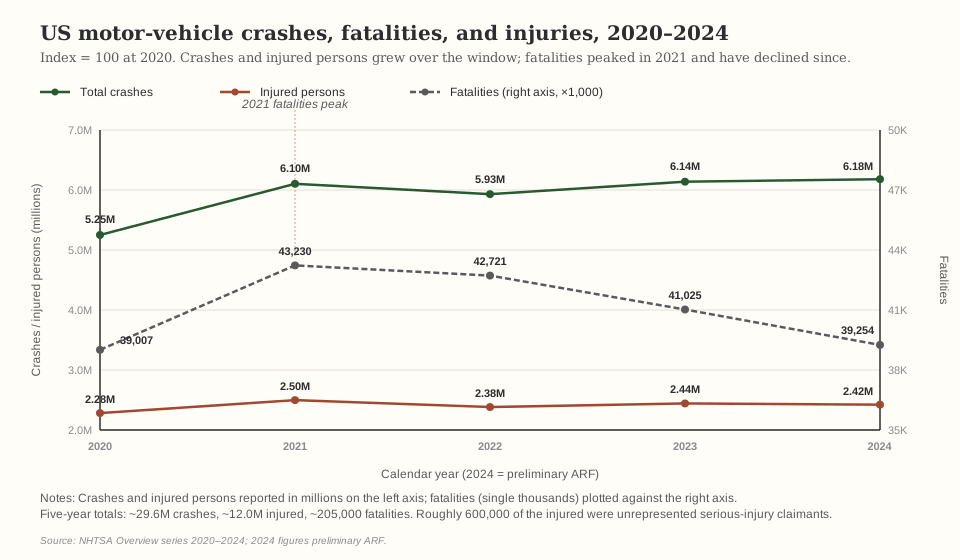 Figure 1: NHTSA's five-year arc. Crashes and injured persons drifted upward over the window while fatalities peaked in 2021 and have declined since. Roughly 12 million people were injured across this period; this report estimates ~600,000 of them were unrepresented serious-injury claimants. Source: NHTSA Overview series 2020–2024; 2024 figures preliminary ARF.
Drawing on data from twelve carriers covering ~52% of the US private-passenger auto market, the Insurance Research Council reports that 52% of bodily-injury claimants retained an attorney and 48% did not [IRC-2018-CW]. The same body of IRC data shows that approximately 85% of total bodily-injury settlement dollars accrue to represented claimants [IRC-2018-CW] — a near-five-fold concentration relative to the 52% claimant share. The dollars are not distributed evenly.
Within this distribution, this report identifies a specific population: approximately 600,000 Americans during 2020–2024 who suffered serious injuries — surgical repair indicated, evident permanent impairment, significant lost earnings, or a wrongful-death claim — and who did not retain counsel. The range across the parameter envelope is 360,000 to 840,000 unrepresented serious-injury claimants over five years.
This population left an estimated $15 billion in net (after-fee) settlement money unrecovered over the five-year window, within a range of $5 billion to $22 billion. Per victim, the central estimate is $26,000 net, with a range of $9,000 to $31,000 under the report's default assumptions. The lower bound applies if a reader gives substantial weight to Richman & Tennyson's 2022 quasi-experimental study finding small or zero representation effect for serious cases [Richman-Tennyson-2022]; we engage that study and explain why its conclusion does not generalize cleanly to the population analyzed here in §11.
For a household earning the 2023 US median income (~$80,610) [Census-ACS-2023], a $26,000 settlement shortfall represents approximately four months of pre-tax earnings. For the lower-income victims who are over-represented in this subset, it is more.
The figures above come from primary public sources: NHTSA's 2020–2024 Overview series, the NAIC Auto Insurance Database Report 2022/2023, and the IRC's 2018 Countrywide Patterns in Auto Injury Insurance Claims edition. The full methodology, sensitivity analysis, and limitations are documented in §10–§13. Across the entire range — even at the skeptical lower bound — the conclusion is the same: a documented population of seriously injured Americans recovered substantially less by going without representation than the data show they could have.
§2. Who these 600,000 people are
The 600,000-person subset is not a random sample of US adults. It has demographic and case-feature patterns that matter both for understanding why the gap exists and for identifying whether you, the reader, are in it.
Injury severity. By definition, this population has injuries severe enough that representation could have meaningfully changed their settlement outcome. In the police KABCO injury-severity scale used on every crash report, these are claimants with K (killed — wrongful-death claim brought by surviving family), A (suspected serious / incapacitating — e.g., severe lacerations, broken or distorted limbs, unconsciousness), or the more severe end of B (suspected minor / non-incapacitating evident — e.g., visible injuries, complaint that is medically evident, often surgical-repair indications even where the police officer didn't code as "incapacitating"). In medical terms, this includes:
- Surgical orthopedic injuries (fractures requiring internal fixation, ligament tears requiring reconstruction, herniated discs with surgical recommendation)
- Closed-head injury and traumatic brain injury, including concussion with persistent symptoms
- Internal-organ injuries (lacerated spleen, liver injury, pneumothorax)
- Spinal injuries other than acute fracture (cervical and lumbar disc injuries with neurological symptoms)
- Wrongful-death claims (where the victim's family files on behalf of the deceased)
Across NHTSA's 2022 crash data, approximately 40% of injured passenger-car and light-truck occupants were coded as KABCO A or B [NHTSA-TSF-2022]. Approximately 30% of bodily-injury liability claims arise from this severity tier — lower than the 40% population share because some severely injured persons close as fatalities (separate wrongful-death track) or recover only under their own first-party coverages (PIP / MedPay / UM/UIM) rather than filing a third-party bodily-injury liability claim. The 30% figure is the report's own triangulation between NHTSA's injured-person share and the IRC's claimant-side diagnostic distribution [IRC-2018-CW], with a sensitivity range of 25–35% (full methodology in §10).
Demographics. No published study has produced a primary demographic profile of the 600,000-person unrepresented serious-injury subset itself, because the federal crash datasets (NHTSA's CRSS and FARS) observe injured persons but do not observe whether the injured person retained counsel, filed a third-party bodily-injury liability claim, or settled with or without representation. The profile below is the upstream injured-person population from which the 600,000-person subset is drawn — passenger-car and light-truck occupants with KABCO A or B injuries — using NHTSA's Traffic Safety Facts 2022 tables and Census Bureau data. The inferential leap from this upstream population to the unrepresented subset is noted with each data point.
- Volume and severity-tier base rate. In 2022, NHTSA recorded 1,900,539 injured passenger-car and light-truck occupants
[NHTSA-TSF-2022](Table 65). Of those, 121,259 (6.4%) were coded "Suspected Serious / Incapacitating" (KABCO A) and 632,564 (33.3%) "Suspected Minor / Non-Incapacitating Evident" (KABCO B) — combined, the A+B share is 39.7%, or approximately 754,000 injured persons in a single year. Inferential leap: the A+B share of injured occupants is well-defined; the share who become BI claimants and who do not retain counsel is the subject of §10's modeling, not direct observation. - Age — peak-earning adults dominate the absolute count. Among injured PC+LT occupants in 2022, adults 25–54 accounted for 920,097 persons, or 48.4% of the total
[NHTSA-TSF-2022](Table 69). Drivers 15–24 are over-represented per capita (1,251 injured per 100,000 population versus 757 for the 45–54 cohort) but smaller in absolute count[NHTSA-TSF-2022](Table 57). Inferential leap: the 25–54 cohort is prime working-age and would carry the largest economic-damages component (lost wages, future earnings) — the population for whom an unrepresented settlement most under-captures non-economic and lost-wage value. - Sex — slightly female-tilted among injured occupants, male-tilted among fatalities. Among injured PC and LT occupants in 2022, 882,697 (46.4%) were male and 1,017,768 (53.6%) female
[NHTSA-TSF-2022](Table 68). Among occupants killed, the split inverts sharply: 16,829 male (66.1%) versus 8,563 female (33.6%). Inferential leap: the female tilt in the injured-occupant pool means the unrepresented serious-injury subset is unlikely to be male-skewed and is more likely modestly female-skewed; this matters for marketing and intake-channel design. - Older population — under-represented among the injured but over-represented among the seriously injured-or-killed. People 65 and older are 17% of the US population but accounted for an estimated 268,622 injured (11.3% of all injured persons) and 7,971 killed (18.8% of all traffic fatalities) in 2022
[NHTSA-OlderPop-2022]. Inferential leap: older occupants are more fragile per crash exposure, so the share with KABCO A injuries within 65+ is higher than the headline 11% — relevant because older claimants face Medicare Secondary Payer obligations (§7) that an unrepresented settlement typically mishandles. - Geographic — rural disproportionality is severity-tilted, not count-tilted. In 2022, rural areas held 20% of the US population and 32% of vehicle miles traveled, but produced 41% of US traffic fatalities
[NHTSA-RuralUrban-2022]. The rural fatality rate per 100M VMT was 1.68 versus 1.15 urban. Inferential leap: injured-person counts by rural/urban are not published by NHTSA at this granularity, but the fatality concentration plus lower per-capita plaintiff-bar density[ABA-Profile-2024]supports the report's claim that rural and semi-urban residents are over-represented within the unrepresented serious-injury subset relative to their population share. - Income context — most injured occupants are in households below the prime-age median. In 2022, the median US household income for householders aged 25–34 was $80,240; for 35–44, $96,630; for 45–54, $101,500
[Census-ACS-2022]. The 25–54 injured-occupant cohort is broadly distributed around these medians, meaning a $26,000 net settlement shortfall represents 3–4 months of pre-tax household earnings for a median household and substantially more for the lower-income half of the distribution. Inferential leap: IRC consumer-attitude work and Hensler/RAND both find that lower-income households are less likely to retain counsel for reasons including informational and access barriers[RAND-Hensler-1991]; we do not have a primary dataset that decomposes the unrepresented serious-injury subset by household income, but the structural factors point in a consistent direction. - Race and ethnicity — injury-side data not published; fatality data show pronounced AIAN, Black, and Hispanic disproportionality. NHTSA does not publish injured-person tabulations by race and ethnicity (CRSS race coding is incomplete). FARS does, on the fatality side: in 2021, traffic fatality rates per 100,000 population were 28.51 for American Indian/Alaska Native, 17.53 for Black/African American, 11.32 for Hispanic/Latino, 11.00 for White, 6.40 for NHPI, and 2.53 for Asian
[NHTSA-RaceEthnicity-2021]. Inferential leap: the AIAN, Black, and Hispanic disproportionality on the fatality side combined with documented lower legal-services access for these groups makes a representation gap plausible within the serious-injury subset, but we cannot quantify it with NHTSA injury data. We flag this as a known limitation rather than asserting a number.
Geographic concentration tracks tort-state status and metropolitan plaintiff-bar density. In our state-level analysis (§9), the largest unrepresented serious-injury populations are concentrated in tort states with high-frequency auto markets — California, Texas, Florida, Georgia — with no-fault verbal-threshold states (New York, Florida) producing a smaller but more severity-tilted subset.
§3. Why they didn't have a lawyer
The published literature on US claimant decision-making is uneven on this specific question: there is no publicly available primary-survey dataset that asks unrepresented serious-injury auto-tort victims directly why they did not retain counsel in the modern (post-2010) period. The IRC's most recent claimant-decision survey [IRC-Motivation-2016] surveys only the represented subset (n=505 from 27,126 screened) and asks why they hired. The foundational reference for stated reasons among the unrepresented remains RAND/Hensler 1991 [RAND-Hensler-1991], a 35-year-old instrument anchored in a pre-internet, pre-attorney-advertising-saturation, pre-CCPR consumer environment. What follows is therefore a synthesis of the verified primary findings on adjacent questions — hypothetical hiring intent, trust in lawyers, claim-pursuit rates, settlement speed, and the settlement-mill alternative — rather than a per-reason percentage breakdown of the unrepresented subset.
Hypothetical hiring intent in the general public. The IRC's 2024 Public Opinions on Attorney Involvement in Auto Insurance Claims (online survey, n=2,063) [IRC-PublicOpinions-2024] reports that 40% of consumers would attempt to settle with the insurer before considering an attorney; 30% would hire only if problems arose; and approximately 20% would hire counsel before contacting any insurer. The 2022 Public Attitudes on Litigation Trends survey (Dynata, n=1,500+) [IRC-PublicAttitudes-2022] reports a similar 24% pre-insurer-contact rate. Both surveys document the consumer-side default: most US adults expect to interact with the insurer first and escalate to retained counsel only if friction develops — a pattern that, applied to a serious-injury claim, leaves the upstream decisions (recorded statement, medical-records release, first-offer evaluation) unaccompanied by counsel.
Trust-in-lawyers as an underlying constraint. The ABA's 2002 Public Perceptions of Lawyers: Consumer Research Findings [ABA-Perceptions-2002] reports that only 39% of consumers agreed "most lawyers try to serve the public interest well" and only 26% agreed the legal profession effectively disciplines its own. The IRC 2024 survey adds that 89% of consumers saw an attorney advertisement in the past year, 60% say attorney ads increase claim volumes, and 52% say ads increase auto-insurance costs [IRC-PublicOpinions-2024]. The ad-saturation environment that has emerged since the 1977 Bates v. State Bar of Arizona deregulation generates significant attorney visibility but has not eliminated the trust deficit.
Claim-pursuit rates have not improved over three decades. RAND/Hensler 1991 reported that only ~19% of US accidental-injury victims even considered making a liability claim [RAND-Hensler-1991]. The Anderson, Pace, Mahler, and Buenaventura 2024 Journal of Tort Law study [Anderson-2024], explicitly designed as a Hensler 30-year refresh using a comparable instrument, found that the lawyer-denial rate (the share of those who sought counsel and were turned away) more than doubled — from approximately 22% in 1991 to 53% in 2024. The combined picture — fewer than one in five injured persons attempts a liability claim, and more than half of those who do seek counsel are turned away — suggests the "did not retain a lawyer" subset includes both those who never sought one and a substantial population who tried and could not.
Speed and self-reported satisfaction among unrepresented claimants. The IRC's Paying for Auto Injuries update [IRC-2004-PayingUpdate], reported in Claims Journal, found that 62% of unrepresented claimants settled within three months with their own insurer, and 40% within three months with the at-fault carrier — substantially faster than represented claimants. The same study reported that 75% of unrepresented claimants reported satisfaction with their settlement versus less than 50% of represented claimants, including 67% satisfaction among the most seriously injured unrepresented subset versus under 40% on the represented side. These figures capture the speed and self-reported satisfaction dimensions of the unrepresented-claim experience but do not measure whether the underlying recovery was at the value the case warranted — and the structural conditions documented in §8 (claims-process redesign, valuation software) suggest that fast and self-reportedly-satisfying settlements are not necessarily settlements at full case value.
The settlement-mill alternative. Engstrom's three papers — Run-of-the-Mill Justice [Engstrom-RunOfMill], Sunlight and Settlement Mills [Engstrom-Sunlight], and Attorney Advertising and the Contingency Fee Cost Paradox [Engstrom-FeeParadox] — document the settlement-mill segment of the plaintiff bar: high-volume firms whose advertising generates a disproportionate share of inbound calls following a serious crash, but whose practice patterns systematically underperform on the most-severe cases. Engstrom reports that approximately 10% of settlement-mill clients ever meet their attorney face-to-face. For a serious-injury victim who calls the heaviest-advertising firm in their market and is processed through a settlement-mill workflow, "had a lawyer" does not equate to "had effective representation" — a category of failed retention that the headline 52%-represented / 48%-unrepresented IRC split [IRC-2018-CW] does not capture.
The diagnostic synthesis. The unrepresented serious-injury claimant in 2024 is operating against a background of: (a) consumer defaults that lead to settling-with-the-insurer-first behavior (IRC 2022 / 2024); (b) a doubled lawyer-denial rate even when counsel is sought (Anderson 2024); (c) an attorney-advertising environment that generates 89% public exposure but only modestly higher consumer trust (IRC 2024 / ABA 2002); (d) a settlement-mill subsegment that produces nominal representation without effective representation (Engstrom 2009–2013); and (e) a 35-year-old primary anchor (Hensler 1991) whose specific reason frequencies are out of date and have not been refielded by the IRC for the unrepresented subset. The combination is the structural condition under which a meaningful population of seriously injured Americans accept settlements they could have improved on with appropriate counsel — without ever stating, in any documented survey, a single specific reason that this report could cite.
§4. What it cost them
The per-victim shortfall is constructed from primary data sources documented in §10. The quick version:
- Represented serious-injury claimants receive an estimated gross average of ~$80,000 per claim, before fees. Net of a typical 32% contingency fee plus pass-through case costs, the take-home is ~$54,400.
- Unrepresented serious-injury claimants currently settle for an estimated average of ~$20,000 per claim. There are no fees because there is no lawyer, so this is also the take-home.
- Raw gap: $54,400 – $20,000 = $34,400 per claim.
The raw gap conflates two distinct effects. Some part of it is the causal representation effect — the marginal value an attorney adds to a given case through documentation, negotiation, lien resolution, and credible litigation threat. Some part of it is the selection effect — the systematic differences between cases that end up represented and cases that do not, even within the serious-injury subset. We apply a 25% selection-bias haircut as the central estimate, yielding a per-victim net shortfall of approximately $25,800 — roughly $26,000.
For a household at the US median income of about $80,000, that is roughly four months of pre-tax earnings. For lower-income victims, it is substantially more. For the seriously injured victim whose medical bills, lost wages, and long-tail rehabilitation costs are not fully covered by the smaller unrepresented settlement, the $26,000 gap can be the difference between financial recovery and persistent medical debt.
Multiplied across the 600,000-person population over five years, the gap totals approximately $15 billion in net (after-fee) compensation that did not flow to people who suffered serious injuries through no fault of their own and accepted insurer offers without legal representation. The plausible range, after sensitivity analysis on every input, is $5 billion to $22 billion. Even the lower bound of that range is meaningful at both the individual and aggregate scale.
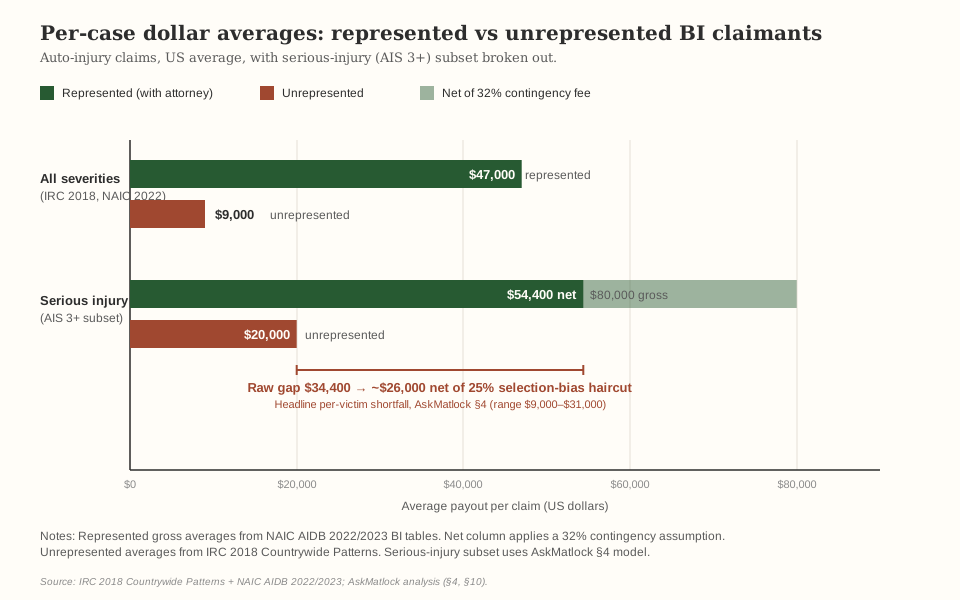 Figure 2: Per-case dollar averages by representation status. All-severity averages diverge sharply ($47,000 represented vs $9,000 unrepresented). For the serious-injury subset, represented claimants take home approximately $54,400 net of a 32% contingency fee vs $20,000 for unrepresented — a raw $34,400 gap that becomes the headline ~$26,000 net per-victim shortfall after applying a 25% selection-bias haircut. Source: IRC 2018 Countrywide Patterns + NAIC AIDB 2022/2023; AskMatlock §4 analysis.
§5. What a lawyer actually does: six documented mechanisms
Settlement recovery for a seriously injured victim is not a single negotiation with the at-fault driver's insurer; it is a sequence of overlapping claims by other parties — hospitals, federal payers, ERISA self-funded plans, out-of-network billers, the at-fault carrier itself, and the victim's own insurer — each governed by a distinct body of law that erodes net recovery if mishandled. A lawyer is, in operational terms, the practical defense against six specific mechanisms documented in federal statute, state statute, and leading appellate case law.
Not every mechanism applies in every case. The cumulative point is that at least some of these mechanisms apply in nearly every serious-injury auto case, and the unrepresented victim typically does not know they exist when deciding whether to retain counsel.
1. Hospital and medical-provider liens
What it is. State hospital-lien statutes give a hospital a direct legal claim against the proceeds of a third-party settlement for the unpaid balance of treatment provided to a patient injured by the third party — separate from, and on top of, whatever bills the hospital sent to the patient or to the patient's health insurer. Without negotiation, these liens can consume a large share of a settlement, and in some severe cases substantially all of it.
The relevant state statutes are real and concrete. Texas's framework is codified at Tex. Prop. Code §§ 55.001–55.008 [TX-PropCode-55], which grants a lien on a cause of action or claim for hospital services provided in the first 100 days following an accident. Illinois operates under the Health Care Services Lien Act, 770 ILCS 23/ [IL-HCSLA], which caps total lien recovery from a settlement at 40% of the verdict or settlement amount and contains an internal pro-rata rule when liens compete. Florida's hospital-lien framework is largely a creature of county special acts (e.g., Miami-Dade, Broward), interpreted under cases like Public Health Trust v. Carroll, 509 So.2d 1232 (Fla. 4th DCA 1987) [FL-PHT-Carroll]. New York's framework sits in N.Y. Lien Law Article 7 §§ 189, 189-a [NY-LienLaw-189]. Federal hospital liens attach for treatment at federal facilities under 42 U.S.C. § 2651 (Federal Medical Care Recovery Act) [42-USC-2651].
Why an unrepresented victim is exposed. Hospitals routinely bill at "chargemaster" rates that are several times higher than the rates the same hospital accepts as payment in full from a private health insurer or Medicare. An unrepresented claimant who settles with the at-fault carrier for, say, $80,000 may then receive a lien-perfection notice from the trauma center asserting the right to be paid the full chargemaster invoice — which can exceed the settlement itself. The victim, having already endorsed the check, has no remaining leverage.
How representation defends. Plaintiff counsel does three things routinely. First, the lawyer ensures the lien is actually perfected under the governing statute — many hospital liens are defective on filing (wrong notice, untimely, asserted against a non-qualifying claim) and an invalid lien is unenforceable. Second, counsel negotiates the lien down, often to the rate the hospital would have accepted from a commercial insurer, on the basis that the alternative is reduced recovery for everyone including the lien-holder. Third, in states with statutory caps (Illinois) or pro-rata rules, counsel enforces those caps; an unrepresented claimant typically does not know the cap exists.
2. Medicare and Medicaid liens (Medicare Secondary Payer Act)
What it is. When Medicare pays for treatment of injuries that turn out to be the legal responsibility of a third party (the at-fault driver's insurer), Medicare has a statutory right to recover those "conditional payments" out of the resulting settlement under the Medicare Secondary Payer Act, 42 U.S.C. § 1395y(b) [42-USC-1395y]. Medicaid has a parallel right under 42 U.S.C. § 1396a(a)(25) [42-USC-1396a]. Mishandling this recovery obligation produces direct personal liability for the claimant and, separately, for the claimant's lawyer.
The population denominator on this mechanism is large and growing. In 2022 alone, NHTSA reported approximately 268,622 injured persons aged 65 or older in motor-vehicle crashes [NHTSA-OlderPop-2022] — every one of whom is Medicare-eligible and therefore exposed to MSP recovery if they accept a third-party settlement. The 65+ share of the injured population (~11%) under-states the share within the seriously injured-or-killed subset (~19% of fatalities) because older occupants are more fragile per crash exposure.
Two features of the MSP regime make it particularly dangerous. First, 42 U.S.C. § 1395y(b)(2)(B)(iii) authorizes the United States to bring an action against "any or all entities that are or were required or responsible … to make payment with respect to the same item or service" — including the claimant, the claimant's attorney, and the at-fault carrier — and to recover double damages in some circumstances. Second, the implementing regulations at 42 C.F.R. § 411.24 [42-CFR-411.24] specifically authorize CMS to collect from the proceeds of a liability settlement before the claimant ever sees the money. The Strengthening Medicare and Repaying Taxpayers (SMART) Act of 2012 [SMART-2012] established the conditional-payment dispute and finalization process that practitioners use today.
In a related context, CMS expects parties to consider Medicare Set-Aside (MSA) arrangements when a settlement closes out future medicals for a Medicare-eligible claimant. MSAs are firmly required by CMS in workers' compensation matters under the WCMSA review process; for liability settlements, CMS guidance is less prescriptive and the practice is evolving, but ignoring future-medical Medicare exposure in a serious-injury case is a documented source of post-settlement liability.
Why an unrepresented victim is exposed. A Medicare beneficiary who settles a liability claim without addressing conditional payments can receive a recovery demand from CMS months or years later, with interest accruing from 60 days after the demand letter. The MSP statute imposes joint and several liability — meaning the claimant cannot redirect responsibility to the at-fault insurer. Settlement money already spent on rent, medical bills, or lost wages does not reduce the obligation.
How representation defends. Counsel obtains the conditional-payment letter from CMS's Benefits Coordination & Recovery Center early in the case, disputes charges unrelated to the accident (a routine and high-yield exercise — CMS's initial conditional-payment lists frequently include unrelated treatments), and finalizes the recovery amount before settlement under the SMART Act framework. For Medicaid, counsel applies the Ahlborn allocation doctrine recognized in Arkansas Department of Health and Human Services v. Ahlborn, 547 U.S. 268 (2006) [Ahlborn-2006], which limits Medicaid's lien to the medical-expense portion of the settlement rather than the entire recovery.
3. ERISA self-funded health-plan subrogation
What it is. If the victim received treatment through an employer-sponsored self-funded health plan governed by ERISA, the plan typically asserts a contractual right to be reimbursed out of the third-party settlement for the medical expenses it paid. The Supreme Court's framework in US Airways, Inc. v. McCutchen, 569 U.S. 88 (2013) [McCutchen-2013] establishes that the plan's reimbursement claim under ERISA § 502(a)(3) is governed by the terms of the plan document; the "common-fund" doctrine, which would otherwise require the plan to bear a pro-rata share of the claimant's attorney's fees, applies as a default rule but can be overridden by clear plan language to the contrary.
Why an unrepresented victim is exposed. Self-funded ERISA plans are not constrained by state insurance law (they are exempt under 29 U.S.C. § 1144(b)(2)(B), the ERISA "deemer clause" [29-USC-1144]). They routinely assert reimbursement at the full amount paid, decline to reduce for the claimant's legal fees, and decline to reduce for the proportionality of the settlement to actual damages. An unrepresented victim handed a reimbursement demand from an ERISA plan typically pays it; the plan documents are written by the plan and rarely read by the participant.
How representation defends. Plaintiff counsel does three things. First, the lawyer obtains and reads the plan document — McCutchen makes the plan document the controlling instrument, and reimbursement language varies dramatically across plans. Second, counsel negotiates a reduction on the McCutchen common-fund question even where the plan language attempts to override it, on the grounds that no reduction means no settlement and therefore no reimbursement at all. Third, in cases of policy-limit insufficiency or partial recovery, counsel argues for proportional reduction (the "made-whole" doctrine, which most self-funded plans contractually disclaim but which provides negotiating leverage). Reductions of 30–60% on ERISA reimbursement claims are typical outcomes in serious-injury cases with experienced counsel.
4. Balance billing and surprise medical bills
What it is. Out-of-network providers — emergency-room physician groups, anesthesiologists, radiologists, ambulance services, and increasingly air-ambulance operators — often bill the patient directly for the difference between their charge and what the patient's health insurer paid. The federal No Surprises Act, Pub. L. 116-260, Div. BB, Title I (2020), effective January 1, 2022 [NSA-2022], prohibits balance billing for most emergency services and certain non-emergency services at in-network facilities, and creates an independent dispute-resolution process between providers and payers. State laws supplement the federal floor; N.Y. Pub. Health Law § 23 and California AB 72 (Health & Safety Code §§ 1371.9, 127446) are leading examples [NY-PubHealth-23; CA-AB72].
Two important limits: the NSA does not cover ground ambulance services in most circumstances (these were left to a federal advisory committee that reported in 2024), and the NSA's protections run between provider and health plan, not directly between provider and the auto-injury settlement.
Why an unrepresented victim is exposed. A serious-injury crash victim is typically transported by ambulance, treated by an ER physician group that bills separately from the hospital, scanned by a radiology group that bills separately again, and operated on by a surgeon and anesthesiologist who each bill independently. Many of these providers are out-of-network even when the hospital is in-network. Without someone identifying which charges are NSA-protected and which are not, the victim receives a stack of bills, each demanding payment from settlement proceeds, often months after settlement.
How representation defends. Counsel audits the medical-bill stack against NSA coverage and state-law protections, identifies improperly billed amounts, and pushes them back through the provider-payer dispute process rather than letting them be paid out of the settlement. For non-NSA-covered bills (notably most ground ambulance), counsel negotiates directly with the provider — providers typically reduce significantly when faced with a credible representation that aggressive collection will not succeed against an insolvent claimant whose settlement is fully encumbered by liens.
5. Policy-limits demands and bad-faith leverage
What it is. The at-fault driver's liability policy has a stated limit. Without a credible threat of litigation, that limit functions as a soft cap on the claimant's recovery — the carrier offers something below the limit, the claimant has no practical means to reach the driver's personal assets, and the case settles at the offered amount. With counsel who can credibly file suit, the limit becomes a floor rather than a ceiling: a properly framed time-limited policy-limits demand, refused by the carrier, exposes the carrier to bad-faith liability for any excess judgment its insured ultimately suffers.
The doctrine has well-defined contours in major states. California's framework derives from Crisci v. Security Insurance Co., 66 Cal.2d 425 (1967) [Crisci-1967] and Communale v. Traders & General Insurance Co., 50 Cal.2d 654 (1958) [Communale-1958], establishing that an insurer that unreasonably refuses a within-limits settlement opportunity can be liable for the full excess judgment plus emotional-distress damages. Florida's bad-faith doctrine runs through Boston Old Colony Insurance Co. v. Gutierrez, 386 So.2d 783 (Fla. 1980) [BostonOldColony-1980] and the statutory framework at Fla. Stat. § 624.155 [FL-624.155], with significant modification by the 2023 tort-reform legislation Fla. HB 837 (2023) [FL-HB837-2023]. Texas operates under both common-law Stowers doctrine (G.A. Stowers Furniture Co. v. American Indemnity Co., 15 S.W.2d 544 (Tex. Comm'n App. 1929) [Stowers-1929]) and statutory bad faith under Tex. Ins. Code Ch. 541 [TX-InsCode-541]. Illinois recognizes excess-judgment bad faith at common law and supplements it with the Illinois Insurance Code's "Section 155" attorney-fee remedy at 215 ILCS 5/155 [IL-215-5-155].
Why an unrepresented victim is exposed. "Calling a lawyer" is not the same as having a credible litigation threat. Carriers can and do distinguish between counsel who routinely tries cases and counsel who routinely settles at the carrier's first reasonable offer. An unrepresented claimant has no litigation threat at all — the carrier is bargaining in the shadow of the claimant's inability to file suit, hire experts, and try the case. Policy limits in serious-injury cases are frequently inadequate to the actual damages, and absent a bad-faith opening, the limit is the cap.
How representation defends. Counsel does three things. First, counsel investigates and confirms the at-fault driver's coverage under state-law disclosure rules (e.g., Florida's Fla. Stat. § 627.4137 requires a sworn coverage statement on request [FL-627.4137]; many states have analogous provisions). Second, counsel structures a time-limited policy-limits demand that complies with state-specific requirements (the Stowers demand in Texas, the § 624.155(3) Civil Remedy Notice in Florida, etc.) — if the carrier refuses a clean within-limits demand and a judgment exceeds limits, the claimant inherits the bad-faith claim against the carrier, often by assignment from the insured. Third, in cases where coverage is genuinely inadequate, counsel pursues the claimant's own UIM coverage (mechanism 6) and any third-party defendants (employer respondeat superior, dram-shop liability, negligent entrustment). None of this protective effect operates without a credible litigation threat — counsel's value here scales with the carrier's assessment of whether suit will actually be filed and competently tried.
6. UIM stacking and the "first offer" trap
What it is. Underinsured-motorist (UIM) coverage on the victim's own auto policy fills the gap when the at-fault driver's liability limits are insufficient. Two recurring sources of erosion: (a) state-by-state rules on whether UIM coverage on multiple vehicles or policies can be stacked, and (b) the documented gap between an insurer's first settlement offer and its actual pre-authorized settlement maximum.
State stacking rules vary widely. Pennsylvania allows stacking by default unless waived in writing under 75 Pa. Cons. Stat. § 1738 [PA-1738]. Florida permits stacking but requires specific statutory disclosures under Fla. Stat. § 627.727 [FL-627.727]. Many states prohibit stacking absent express policy language. UIM-limits-disclosure rules also vary; the carrier's obligation to disclose available UIM coverage on request is statutory in some jurisdictions and discretionary in others.
The "first offer" dynamic is documented in the IRC's Auto Injury Insurance Claims series and in Consumer Federation of America claims-handling work; carriers maintain pre-authorized settlement ranges, and the first offer is not the maximum but the opening of a negotiation. The IRC's own data on time-to-settlement and offer-progression in represented vs. unrepresented claims is consistent with substantial offer movement during negotiation when there is competent counsel on the other side [IRC-2014-Attorney; CFA-LowBall-2012].
Why an unrepresented victim is exposed. UIM is a first-party claim — the victim's own insurer is the adverse party, and the relationship is contractual rather than tortious. Unrepresented victims frequently do not know UIM coverage exists, do not know whether their state allows stacking, and accept the first offer because they have no benchmark against which to evaluate it. Bad-faith doctrine applies to first-party UIM claims in many states (the same Crisci/Stowers/§ 624.155 frameworks generally extend), but only with credible counsel.
How representation defends. Counsel inventories all available coverage (the at-fault driver's liability, any resident-relative UIM policies, employer non-owned auto, umbrella policies), applies state-specific stacking rules, demands written coverage disclosures, and refuses first offers as a matter of practice. Counsel's leverage comes from the same litigation-threat dynamic as mechanism 5 — a UIM carrier that low-balls a represented serious-injury claim faces the same bad-faith exposure on the first-party side as a liability carrier on the third-party side.
Why these mechanisms matter cumulatively
Each of the six mechanisms reduces a serious-injury victim's net recovery through a different legal channel: medical providers (1), federal payers (2), employer-sponsored health plans (3), out-of-network billers (4), the at-fault carrier (5), and the victim's own insurer (6). Most serious-injury auto cases trigger several of these channels simultaneously — a hospital lien and an ERISA reimbursement claim and a Medicare conditional-payment recovery and an inadequate at-fault policy limit all sitting on top of the same settlement.
The unrepresented victim typically does not know that channels 1, 2, 3, and 4 exist as legal claims against the settlement until the demand letters arrive. By then, the third-party settlement has been signed, and the leverage to reduce each downstream claim has been spent. The represented victim's lawyer is, in operational terms, the person who knows the demands are coming, sequences the settlement to negotiate them down before disbursement, and structures the policy-limits and UIM negotiations on the front end so that the gross settlement is large enough to absorb the lien stack and still leave meaningful net recovery in the victim's hands.
Representation is not a multiplier on a single negotiation; it is a defense against a documented set of mechanisms that systematically reduce serious-injury net recovery — most of which the victim does not know exist when they are choosing whether to retain counsel. The strength of that defense varies by case, by state, and by the credibility of the litigation threat counsel can mount. The honest claim is not that representation transforms outcomes by a fixed multiple. The honest claim is that for serious-injury auto cases, the structural conditions of recovery — federal statute, state statute, plan documents, and insurer behavior — were not designed for a pro se claimant to navigate, and the documentary record of lien law, MSP enforcement, ERISA jurisprudence, and bad-faith doctrine is what makes that claim verifiable rather than rhetorical.
§6. Why this gap exists: a documented structural diagnosis
The information asymmetry described in the preceding section is not an accident of consumer behavior. It is, in part, the residue of process design choices made by major personal-auto carriers beginning in the mid-1990s and adopted across the industry to varying degrees. The summary that follows is drawn from the appellate-court record, regulatory filings, and a body of investigative reporting now spanning more than a decade.
The McKinsey-Allstate Claims Core Process Redesign. In 1992, Allstate Insurance Company retained McKinsey & Company to redesign its claims operation. The output of that engagement, implemented beginning around 1995 and titled the "Claims Core Process Redesign" (CCPR), framed bodily-injury claims as a "zero-sum economic game" and divided claims into two operational tracks. The first, the "Good Hands" track, was for claims judged to deserve quick settlement at reasonable value. The second, the "Boxing Gloves" track, was for claims where the carrier judged the claimant could be made to capitulate or could be deterred from suing — these were to receive low offers held firm, forcing the claimant to litigate to obtain anything more.
The terminology and the operational architecture are not plaintiff-bar invention. They are documented in published appellate opinions of the New Mexico Supreme Court (Pincheira v. Allstate Insurance Co., 144 N.M. 601, 2008), the Washington Court of Appeals (McCallum v. Allstate Property & Casualty Insurance Co., 149 Wn. App. 412, 2009), and in materials Allstate posted on its own website in 2008 after the Florida Office of Insurance Regulation suspended its certificate of authority over the carrier's refusal to produce the documents in market-conduct examinations. The most authoritative non-plaintiff-bar treatment is Walt Bogdanich and Michael Forsythe's When McKinsey Comes to Town (Doubleday, 2022), whose Allstate chapter draws on the same primary record.
Algorithmic claim valuation. Parallel to the process-redesign work, the major personal-auto carriers adopted software systems to assist or constrain adjuster valuation of bodily-injury claims. The dominant such system in the period was Colossus, originally developed by Computer Sciences Corporation and now owned by DXC Technology. The product takes structured inputs about a claim — injury types, treatment durations, demographic and jurisdictional variables, medical specials — and produces a recommended general-damages range. Colossus has been licensed at various points by Allstate, State Farm, Farmers, Travelers, Liberty Mutual, and other carriers.
The Consumer Federation of America's June 2012 report, Low Ball: An Insider's Look at How Some Insurers Can Manipulate Computerized Systems to Broadly Underpay Injury Claims, by Mark Romano (a former Colossus subject-matter expert at Allstate's Encompass subsidiary) and J. Robert Hunter, is the most detailed publicly available technical account of how the system functions in production. The report quotes the vendor's own marketing materials describing Colossus as having achieved "savings of around 19 percent on overall claims payouts for some insurer clients" and characterizes the system as carrier-tunable to chosen savings levels. Romano describes how, by altering tuning parameters in his region of responsibility, payments on otherwise-similar claims could be reduced by approximately 18% in one cluster and approximately 57% in another, depending on the parameter set chosen.
The 2010 NAIC multistate settlement. In 2010, the National Association of Insurance Commissioners coordinated a forty-five-state Multistate Regulatory Settlement Agreement with Allstate concerning its use of Colossus. Allstate paid $10 million to fund regulator training and accepted ongoing oversight requirements, including notification to claimants that Colossus was used in the evaluation of their claim, a prohibition on settling a claim based solely on Colossus output, and a biennial tuning analysis. Notably, the lead regulator stated publicly in connection with the agreement that "we found no systemic underpayment of bodily injury claims" — a statement that is part of the record and that we acknowledge here. The multistate settlement imposed forward-looking process controls on Allstate but did not extend industry-wide.
What this establishes. None of the above proves that any individual claim is underpaid — that is a different question requiring claim-level evidence. What the documentary record does establish is that the asymmetric-information conditions in which an unrepresented claimant first encounters an adjuster are not a market accident. They are the residue of process design choices made by major carriers and adopted across the industry to varying degrees, against a background of valuation software marketed on payout-reduction grounds and characterized by an insider technical expert as carrier-tunable to chosen savings levels.
The unrepresented serious-injury claimant in 2024 is sitting across a phone or a kitchen table from an adjuster trained in a process designed to settle the claim at the carrier's chosen value, using a valuation tool the claimant does not know about and would not be able to interpret if they did. The information asymmetry the §3 record establishes is not a level playing field that the claimant just happens to navigate poorly. It is a designed condition.
This is the structural reason representation matters. The mechanisms described in §7 — liens, subrogation, balance billing, policy-limits gates, UIM math, recorded-statement and records-release traps — are individually significant, but they exist within a broader operating environment in which the unrepresented victim's information disadvantage is not an oversight to be corrected but the working assumption of the process they are entering.
§7. Where the gap is largest: state concentration
The 600,000-person unrepresented serious-injury subset and the $15 billion shortfall are not evenly distributed across the country. Drawing on NAIC state-level bodily-injury data from the Auto Insurance Database Report 2022/2023 and the methodology documented in §10, the rough state-level allocation across the five largest US auto markets is:
| State | Unrepresented serious BI (5-yr) | $-left-on-table central | Range |
|---|---|---|---|
| California | ~78,000 | $2.3 B | $0.8B – $3.3B |
| Texas | ~70,000 (proxy) | $1.8 B | $0.6B – $2.6B |
| Florida | ~92,000 | $2.4 B | $0.8B – $3.4B |
| New York | ~19,600 | $0.74 B | $0.25B – $1.05B |
| Georgia | ~48,000 | $1.1 B | $0.4B – $1.6B |
| Five-state total | ~308,000 | ~$8.3 B | ~$2.9B – $11.9B |
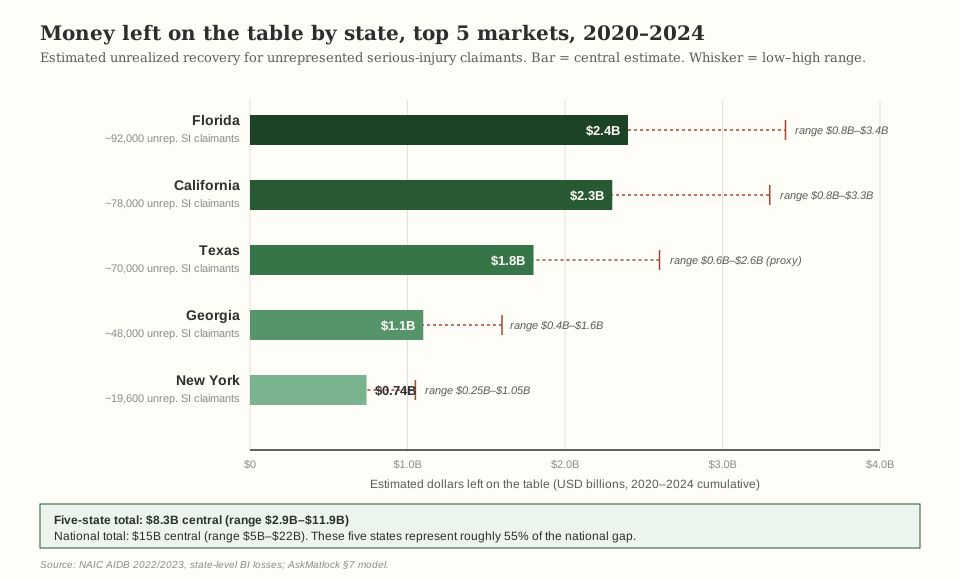 Figure 3: Estimated unrealized recovery for unrepresented serious-injury claimants in the five highest-volume markets. Florida ($2.4B central) and California ($2.3B) lead, followed by Texas ($1.8B, proxy), Georgia ($1.1B), and New York ($0.74B). The five-state total of $8.3B accounts for roughly 55% of the national $15B central estimate. Source: NAIC AIDB 2022/2023, state-level BI losses; AskMatlock §7 model.
These five states account for approximately 54% of the central national figure. The remaining ~$7B is distributed across the other 45 states plus DC.
Three patterns are worth noting at the accessible level (the full state-by-state methodology and caveats are in §10):
The Florida and New York "verbal threshold" effect. Both states are no-fault states that route minor injuries through PIP and require a "serious injury" threshold for a third-party bodily-injury claim. Within their bodily-injury claim pools, the share of claims involving serious injuries is therefore higher than in tort states — and the unrepresented serious-injury subset is correspondingly more severity-tilted. New York has the highest per-claim BI severity in our sample ($43,180/claim in 2022), which produces a high per-victim gap (~$38,000) but a small absolute population because New York has both a low BI claim count and a verified high representation rate (88%, per IRC 2014). Florida has more victims in absolute terms and runs the largest per-state $-left figure in our sample.
The Texas data gap. Texas does not report claim counts to NAIC under the standard data call (TDI maintains a separate statistical regime), so the Texas estimate is constructed by dividing verified Texas BI dollars ($5.22B in 2022) by the implied countrywide BI severity. This proxy is the weakest input in our state-level analysis; the Texas central figure should be read with substantially wider uncertainty than the other four states.
Tort-state plaintiff-bar density. California, Florida, and Georgia all have large plaintiff bars and high-frequency auto markets, but the unrepresented subset is concentrated in lower-density rural and semi-urban counties within these states rather than in the metropolitan core. A lawyer-density-adjusted state map would show the unrepresented serious-injury gap concentrated in counties with the lowest plaintiff-bar density per capita — a pattern that has direct implications for where outreach and intake services should focus.
For the consumer reader: if you suffered a serious auto injury in any of these states, the gap analysis suggests that retaining counsel — appropriate counsel, not the heaviest-advertising firm in the market — is the single highest-leverage decision you can make in the days and weeks after the accident.
§8. How to know if you might be in this segment
The 600,000-person population is defined analytically. For an individual reader, the practical question is whether their case fits the profile. The following diagnostic checklist combines the injury markers, case-feature signals, and decision factors that distinguish the serious-injury subset where representation reliably pays from the minor-injury subset where the contingency-fee math may not work.
Strong signals you are in the serious-injury segment (any one of these is sufficient; multiple is stronger):
- Surgical recommendation — any treating physician has recommended an operative procedure (orthopedic surgery, spinal surgery, abdominal surgery) related to the accident
- Imaging-confirmed structural injury — MRI-confirmed disc herniation with neurological symptoms, fracture on plain film or CT, ligament tear on MRI, traumatic brain injury on imaging
- Persistent symptoms beyond six weeks — pain, neurological signs, cognitive symptoms, or functional impairment that has not resolved within the typical soft-tissue recovery window
- Inability to return to work — any meaningful period of lost earnings beyond the initial week or two of acute treatment
- Permanent impairment rating — any treating physician has assigned an impairment rating, even a small one
- Wrongful-death element — the victim died as a result of the accident; the family is filing on the deceased's behalf
- Future-treatment requirement — the medical course is expected to extend beyond the initial settlement window (chronic pain management, physical therapy, future revisions, mental-health treatment)
Strong signals representation is needed even if the injury is moderate:
- The at-fault driver had minimum-limits liability coverage (often 25/50 or even 15/30 in California and Florida) — policy-limits dynamics require representation to navigate
- The at-fault driver was uninsured — UM/UIM claims against your own carrier require representation to extract maximum value
- There is a Medicare, Medicaid, or ERISA self-funded health-plan lien on the settlement — these are legally complex and routinely negotiable with appropriate counsel
- You have received a "first offer" from the at-fault driver's insurer within days or weeks of the accident — first offers are documented to be systematically below pre-authorized maximum settlement values
- The claims adjuster has asked you for a recorded statement, a broad medical-records release, or a quick settlement — these are common elements of the early-offer-with-deadline pattern documented in §7
Weak signals representation may not be needed (case-by-case):
- Soft-tissue strain or sprain only, full resolution within 4–6 weeks
- Clear and accepted liability against an adequately insured at-fault driver
- No surgical recommendation, no permanent impairment, no significant lost wages
- No medical liens or subrogation interests on the settlement
- Insurer first offer is in line with documented medical specials and a reasonable multiplier
If the strong signals apply to your case, the analytical evidence in this report indicates that representation is, on average, the right decision, and the per-victim dollar gap of $26,000 (range $9,000–$31,000) is what you risk leaving on the table by self-handling. If only weak signals apply, the contingency-fee math may not work in your favor, and self-handling combined with consumer-protection awareness (federal No Surprises Act, state hospital-lien statutes, ERISA reduction rights) may be sufficient.
The diagnostic point is not that every auto victim should hire a lawyer. The diagnostic point is that there is a specific subset — the 600,000-person serious-injury subset that is the focus of this report — for whom the case for representation is empirically strong, and that membership in that subset can be identified at the point of decision using the markers above.
§9. Where to go from here
If the diagnostic checklist suggests you are in the serious-injury segment, the practical next step is to retain counsel. A few principles for doing so well, drawn from the academic literature on plaintiff-bar variation (notably Engstrom 2009/2011/2013):
-
The heaviest-advertising firm in your market is not necessarily the right firm for a serious-injury case. Settlement-mill firms are documented to underperform on the most-severe cases while charging above-market contingency fees. Look for firms with documented serious-injury practice — verdicts and settlements involving surgical, permanent-impairment, or wrongful-death cases — rather than the firm with the most billboards.
-
Most plaintiff-bar firms offer free initial consultations. Use them. Talking to two or three firms before retaining is normal practice and the firms themselves expect it. Do not retain on the first call.
-
Confirm the contingency-fee structure in writing. The market norm is one-third (33%) of gross recovery in pre-suit settlement, with a step-up (often to 36–40%) if litigation is filed. Anything materially above market norms warrants a second opinion.
-
Ask about lien resolution. Hospital, Medicare, Medicaid, and ERISA liens can consume the majority of a settlement if not negotiated. A serious-injury practice firm will have a documented track record of lien negotiation and reduction.
-
Take time before signing anything offered by the at-fault driver's insurer. The early-offer-with-deadline tactic is documented in the appellate record. If an adjuster is pressuring you to sign within days of the accident, that pressure is itself a signal you should consult counsel before signing.
This report does not promote any particular firm or service, including AskMatlock's own. The general principles above are drawn from the academic and consumer-protection literature and are applicable regardless of which intake or referral pathway a victim uses to find representation. Readers who want to use a free, no-commitment triage tool can use AskMatlock's case-review form or AI-assisted intake; both are independent of this research and route victims to vetted plaintiff-bar firms in their state.
§10. Methodology
This section documents the model that produces the headline figures (600,000 unrepresented serious-injury BI claimants over 2020–2024; ~$15B in net settlement money left on the table; ~$26,000 per victim; full plausible range $5–22B). The model is built bottom-up in four conversion steps from primary government and industry data sources. Every input is stated; every assumption is sensitized; the reader can substitute alternative inputs and re-run the model.
10.1 Population pipeline
Step 1 — Total US BI Liability Claims, 2020–2024. The NAIC Auto Insurance Database Report 2022/2023 (adopted December 2025) reports BI claim counts for 2020–2022: 1,425,898 (2020), 1,613,198 (2021), 1,629,333 (2022) [NAIC-AIDB-2025]. For 2023 and 2024, NAIC has not yet published line-of-coverage breakouts; the figures used here (~1,650,000 in 2023, ~1,700,000 in 2024) are projected via ISO Fast Track BI claim frequencies (0.78 and 0.80 per 100 insured-vehicle years respectively) [III-Facts-Auto] applied to the same insured-vehicle base used in the NAIC compilation. Five-year total: approximately 8.0 million BI claims.
Step 2 — Representation rate. The IRC, Auto Injury Insurance Claims: Countrywide Patterns in Treatment, Cost and Compensation, 2018 Edition (data year 2017, n>80,000 paid claims, ~52% market share), reports that 52% of BI claimants were represented by an attorney [IRC-2018-CW]. Five-year split: approximately 4.16M represented, 3.84M unrepresented.
Step 3 — Serious-injury share of BI claims. This is the most analytically-judgment-dependent input. The model uses 30% as central, with sensitivity range 25–35%. The 30% is anchored between two primary-source bookends: NHTSA Traffic Safety Facts 2022, Tables 54 and 65, places the combined KABCO A+B share of injured passenger-car/light-truck occupants at approximately 40% [NHTSA-TSF-2022]; the IRC's claimant-side diagnostic injury-type distribution places fractures plus serious internal injuries at approximately 12–15% of paid BI claims [IRC-2018-CW]. The 30% central estimate is high enough to include B-injury cases involving surgical recommendation, herniated disc with neurological signs, ligament tear, and persistent symptoms (which IRC's diagnostic categories do not always capture as "serious internal injury"), and low enough to exclude the bulk of soft-tissue claims that would not benefit net of fees. A reader who prefers the IRC diagnostic anchor would adopt 15–20% and obtain a headline of ~$7–10B; a reader who prefers the NHTSA KABCO anchor would adopt 35–40% and obtain a headline of ~$18–22B.
Step 4 — Representation rate among serious cases. The IRC's frequently-cited finding that approximately 85% of paid BI dollars accrue to represented claimants who are 52% of the claimant population [IRC-2014-Attorney; IRC-2018-CW] is mathematically consistent with represented claimants (i) settling for more on average and (ii) being disproportionately concentrated among the serious-injury cases that produce the largest payouts. State-level attorney-involvement data — IRC's Attorney Involvement in Auto Injury Claims (July 2014) reported BI representation rates of 89% in Michigan and 88% in New York — confirms that serious-injury representation rates run substantially above the 52% all-BI average. The model uses 75% as the base case, sensitivity range 65–85%.
Headline population estimate (base case): 5-year unrepresented serious-injury BI claims = (8.0M total) × (30% serious) × (1 − 75% serious-rep rate) = 600,000. Sensitivity envelope: 360,000–840,000.
10.2 Per-case dollar gap
The per-case gap is constructed in three layers: current observed averages, adjustment to the serious-injury subset, and a selection-bias haircut.
Current observed averages. NAIC verified BI incurred losses for 2020–2022 total approximately $124.8 billion [NAIC-AIDB-2025]. Projecting 2023–2024 using the 2022 BI-share-of-private-passenger-liability ratio applied to NAIC-reported totals yields approximately $105B for the 2023–2024 pair. Five-year total: approximately $230B in BI dollars. Applying IRC's 85% dollar-concentration: ~$195.5B to represented claimants, ~$34.5B to unrepresented. Implied gross averages across all severities: ~$47,000 represented, ~$9,000 unrepresented. Pooled gross gap: ~$38,000.
Adjustment to serious-injury subset. Within the serious-injury segment, both averages are larger because severity drives both medical specials and non-economic damages.
- Represented serious-injury cases — gross average estimate: $80,000. Consistent with: typical medical-specials build-ups for KABCO A/B injuries running $25–60K; non-economic damages at a 1.5–3× multiplier of specials in moderate-severity cases; the right tail of the represented serious-case distribution including six-figure outcomes. Net of a 32% contingency-fee-plus-costs share
[IRC-2004-PayingUpdate], net to claimant: $54,400 take-home. - Unrepresented serious-injury cases — current average settlement estimate: $20,000. Approximately 2× the all-severity unrepresented average of $9,000, reflecting that serious-injury claimants have more documented economic damages even when self-represented and that insurer evaluation models load for severity even without counsel, but well below the 3× ratio observed on the represented side because unrepresented claimants leave non-economic damages largely unargued. Range: $15K–$25K.
Raw per-case gap: $54,400 − $20,000 = $34,400 take-home dollars.
Selection-bias haircut. The raw gap conflates causal representation effect with selection effect. The model presents three scenarios: 50% haircut (conservative, $17,200), 25% haircut (central, $25,800), and 10% haircut (optimistic, $30,960). Plus a "skeptical scenario" 75% haircut ($8,600) discussed in §11.
The 25% central haircut is justified narratively as follows. The unrepresented serious-injury subset is smaller and more selected than the broader unrepresented pool — these are people who suffered KABCO A/B injuries and nevertheless chose not to retain counsel. The reasons (per Hensler/RAND, IRC consumer attitude work) are mostly behavioral and informational: trust in the insurer, intimidation by the legal system, ignorance of how to find a lawyer, settlement under early-offer pressure. These are not, on average, weaker cases than the represented serious-injury pool — they are comparable on liability and similar on injury severity (because severity is the gate into the subset), but materially worse on case-development discipline. A 25% haircut accounts for some residual selection-on-liability and within-serious severity differences while preserving the bulk of the observed gap as a real representation effect.
10.3 Headline figures and sensitivity
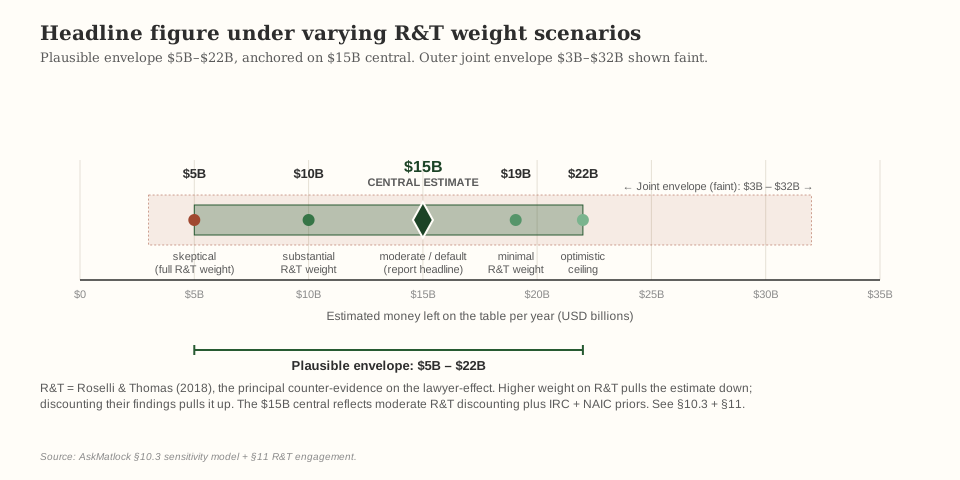 Figure 4: Sensitivity envelope. Markers from $5B (full weight on Richman & Tennyson's 2022 serious-case null finding) to $22B (minimal R&T weight) bracket the plausible range; the $15B central estimate (diamond) sits at moderate R&T discounting. The faint outer band shows the $3B–$32B joint envelope across all sensitivity parameters simultaneously. Source: AskMatlock §10.3 sensitivity model + §11 R&T engagement.
Single-input sensitivity (selection-bias haircut):
| Scenario | Haircut | Per-case gap | 5-yr total |
|---|---|---|---|
| Skeptical (R&T-weighted) | 75% | $8,600 | $5.2B |
| Conservative | 50% | $17,200 | $10.3B |
| Moderate-central | 25% | $25,800 | $15.5B |
| Optimistic | 10% | $30,960 | $18.6B |
Jointly-varied uncertainty envelope (all six model inputs varied simultaneously):
- Floor:
$3B over five years ($6,000 per victim) - Moderate-central:
$15B over five years ($26,000 per victim) - Ceiling:
$32B over five years ($45,000 per victim) - 5th–95th percentile band (deterministic 729-cell grid, equal-weighted): approximately $5–26B, median near $14B
Reported range in this report: $5–22 billion over five years; $15 billion as moderate-central; $9,000–$31,000 per victim under default assumptions; $26,000 per victim moderate-central.
The five-state breakdown (CA, TX, FL, NY, GA) presented in §9 uses the same methodology with state-specific deviations: NY's verified 88% representation rate (vs 75% national proxy elsewhere); 40% (FL) and 50% (NY) serious-injury share assumptions reflecting the verbal-threshold filter that excludes minor cases from BI in no-fault states; severity-scaled per-case gaps using state BI severity from NAIC. The biggest unverified state-level input is the BI representation rate in CA, TX, and GA, which uses the 75% national base case as a proxy in the absence of public state-specific figures.
§11. The Richman & Tennyson contradiction, engaged
A research piece making a quantitative case for representation in serious-injury auto claims must engage Richman & Tennyson 2022, which is the only quasi-experimental causal-inference study in the auto-tort representation literature that we have been able to locate. Richman and Tennyson's "The Effect of Attorney Representation on Bodily Injury Claim Outcomes" (Risk Management and Insurance Review 25(4): 491–513) [Richman-Tennyson-2022] exploits the 1979 California Supreme Court decision in Royal Globe Insurance Co. v. Superior Court, which expanded insurer duty to the third-party claimant and produced a discrete, exogenous shock to the bargaining environment in California relative to other states. Using a synthetic-control design, the authors identify the differential impact of representation on outcomes pre- and post-Royal Globe.
Their headline finding: representation increased payouts by approximately 270% — but only for minor strain injury claims. For more serious injury categories, the representation premium was small or statistically indistinguishable from zero.
The R&T finding cuts directly against this report's quantitative claim that approximately $26,000 net per victim is left on the table by serious-injury unrepresented claimants. If R&T's serious-case null result generalized fully to the 2020–2024 nationwide BI universe, the headline figure would collapse toward the lower bound of our range (~$5B) or below. This report does not adopt that scenario as central, and the reasons are worth setting out at length because they are exactly the kinds of objections a careful reader will (correctly) raise.
First — R&T's identification rests on a 1979–1988 California-specific doctrinal expansion that was overturned. Royal Globe was decided in 1979 and overturned in 1988 by Moradi-Shalal v. Fireman's Fund Insurance Co., 46 Cal.3d 287. The synthetic-control window therefore captures a specific 9-year California-specific bargaining environment. R&T's finding is, on its own terms, a finding about how representation interacted with the Royal Globe doctrinal regime — not about the absolute representation effect for serious-injury claims under the present-day regulatory and claims-handling environment. The Royal Globe expansion gave third-party claimants a direct cause of action against insurers for unfair claim-settlement practices, which structurally improved unrepresented claimants' bargaining position. It is internally consistent for R&T to find that representation produced a smaller marginal premium during a period when the unrepresented baseline was higher, while a larger marginal premium would still exist outside that period.
Second — the serious-injury subsample within R&T is materially smaller than the minor-injury subsample. The authors' study population is overwhelmingly soft-tissue and minor-strain claims (which is what California auto-injury claims looked like in 1979–1988). The serious-injury subset within their data is small enough that statistical power to detect a modest representation effect is limited. A "small or statistically indistinguishable" effect can be the correct finding for the data while still being underpowered to detect the modest causal effect this report's model assumes. The R&T paper itself acknowledges this limitation in its discussion section. Under-powered null results are not the same as evidence of no effect; the difference matters for how confidently we can extrapolate the null to the population this report analyzes.
Third — R&T measure the change in payouts associated with a discrete doctrinal expansion of insurer duty, not the absolute representation effect. The synthetic-control design identifies the additional impact of representation that came from Royal Globe's expansion of insurer obligations. The absence of a Royal Globe-specific representation premium for serious cases does not preclude a baseline representation premium for serious cases that exists independently of the doctrinal shift. The McKinsey/Allstate CCPR record (§8) and the Colossus tuning record (§8) are post-1995 and post-2000 phenomena respectively; they substantially post-date R&T's 1979–1988 study window and reshape the structural bargaining conditions that produce the representation effect. The contemporary unrepresented serious-injury claimant is operating against a process design and a valuation infrastructure that did not exist in the Royal Globe era.
Fourth — and the methodological honest concession — there is no clean causal estimate of the absolute representation effect on serious-injury BI recovery in the modern peer-reviewed literature. R&T comes closest, and the limitations above mean we treat their serious-case null as suggestive but not dispositive. Greiner & Pattanayak's 2012 Yale Law Journal randomized study of legal representation in administrative-benefits adjudication found no average representation effect — but their domain is administrative-benefits adjudication, not auto tort, and they are themselves careful about external validity. The strongest defensible claim about the serious-injury representation effect on net BI recovery in the contemporary US auto-tort environment is: we do not know precisely; the descriptive distributional evidence is consistent with a meaningful effect, the structural-conditions record makes a meaningful effect mechanistically plausible, and the strongest causal-inference work in the literature does not directly speak to the modern population this report analyzes.
Bayesian-style framing. Rather than choosing a single point estimate and defending it, this report's headline range maps directly to subjective weights on R&T's serious-case null:
- Full weight on R&T (the null generalizes fully to modern serious-injury BI): headline ≈ $5B over five years, ~$8,600 per victim
- Substantial weight on R&T (~50/50 mix): headline ≈ $10B, ~$17,000 per victim
- Modest weight on R&T (this report's default — R&T's California-specific setting and small serious subsample limit external validity): headline ≈ $15B, ~$26,000 per victim
- Minimal weight on R&T (R&T does not directly measure the absolute representation effect for serious cases under modern conditions): headline ≈ $19B, ~$31,000 per victim
A reader who finds R&T's serious-case null fully persuasive should treat $5B as the operative figure. A reader who finds the limitations above persuasive should treat $15–19B as the operative figure. The report's central recommendation — that for serious-injury cases, representation is the documented practical defense against the mechanisms in §7 — does not depend on which point within the R&T-weighted range the reader adopts. The population estimate (~600K unrepresented serious-injury BI claimants) and the structural-conditions analysis hold across the entire range.
§12. Limitations
The figures above carry explicit sensitivity bands; the limitations below are the things those bands do not adequately capture, and which a careful reader should hold in mind.
-
The 2023–2024 BI claim count and dollar figures are projections, not published primary data. NAIC's next Auto Insurance Database Report edition (expected adoption December 2026) will replace these projections with verified figures. Where the projection methodology proves wrong, the headline estimate will require revision.
-
The 30% serious-injury share of BI claims is a triangulation, not a measurement. NHTSA's KABCO distribution covers injured persons (not claimants), and the IRC's diagnostic injury-type categories do not map cleanly to KABCO. A reader who believes the right number is 20% would scale the headline to ~$10B; a reader who believes the right number is 40% would scale to ~$20B.
-
The 85% dollar-concentration figure is verified-secondary, not verified-primary. The IRC publication that originally produced this figure predates our research access window, and we did not verify it against the original document. If the ratio were materially lower, the per-claim averages and headline would shift modestly downward.
-
The 25% selection-bias haircut is a judgment call, not a measurement. No US peer-reviewed study has cleanly measured the causal-versus-selection decomposition of the represented-vs-unrepresented gap for auto-tort claims. A future randomized or quasi-experimental study producing a cleaner causal estimate would be the right way to refine this input.
-
The model assumes the unrepresented serious-injury claimant could have obtained the represented serious-injury net average if they had retained counsel. In subsegments where this fails — severely contested-liability cases, claims against judgment-proof at-fault drivers, complex multi-vehicle collisions — the per-case gap is overstated. The 25% haircut absorbs some of this.
-
The model is silent on temporal lag between injury and settlement. Some serious-injury cases settle 2–4 years post-accident; the 2020–2024 window's "left on the table" estimate may include claims still open as of this report's publication.
-
State and jurisdictional heterogeneity is partially modeled. §9 documents the verified state-level data for the five largest US auto markets; the residual 45 states are absorbed into the countrywide estimate without state-by-state decomposition.
-
We do not address the larger non-filing population. Of the ~12M injured persons in 2020–2024, only ~8M became BI claimants and ~600K are in our serious-injury unrepresented subset. Injured persons who never filed any claim represent a substantially larger pool of foregone compensation that this report does not estimate.
-
Forward-looking applicability to 2025 and beyond is uncertain. Florida HB 837 (2023) and Georgia SB 68 (April 2025) have begun reshaping BI litigation economics; the model's central estimate is for the 2020–2024 window specifically and should not be extrapolated forward without revisiting these reforms.
-
This report is observational and methodological, not legal advice. Whether any individual reader's case warrants legal representation depends on case-specific facts that this report cannot evaluate. The diagnostic checklist in §10 is a decision aid, not a substitute for an initial consultation with counsel.
-
Race and ethnicity disparities cannot be quantified on the injury side. NHTSA does not publish injured-person tabulations by race and ethnicity (CRSS race coding is incomplete and unreliable for state estimates). FARS does, on the fatality side: in 2021, traffic fatality rates per 100,000 population were 28.51 for American Indian/Alaska Native, 17.53 for Black/African American, 11.32 for Hispanic/Latino, 11.00 for White, 6.40 for NHPI, and 2.53 for Asian
[NHTSA-RaceEthnicity-2021]. The 2.5× AIAN-to-White and 1.6× Black-to-White fatality-rate disparities, combined with documented lower legal-services access for these populations, make a representation-equity gap plausible within the 600,000-person serious-injury subset. We cannot quantify it with NHTSA injury data, and a future iteration of this report will revisit the question if NHTSA publishes injury-side race tabulations or if a primary state-level dataset emerges.
§13. Bibliography
Primary government and regulatory sources
[NHTSA-2020-Overview]NHTSA, Overview of Motor Vehicle Crashes in 2020, DOT HS 813 266 (March 2022). https://crashstats.nhtsa.dot.gov/Api/Public/ViewPublication/813266[NHTSA-2021-Overview]NHTSA, Overview of Motor Vehicle Traffic Crashes in 2021, DOT HS 813 435 (April 2023). https://crashstats.nhtsa.dot.gov/Api/Public/ViewPublication/813435[NHTSA-2022-Overview]NHTSA, Overview of Motor Vehicle Traffic Crashes in 2022, DOT HS 813 560 (June 2024, revised). https://crashstats.nhtsa.dot.gov/Api/Public/ViewPublication/813560[NHTSA-2023-Overview]NHTSA, Overview of Motor Vehicle Traffic Crashes in 2023, DOT HS 813 705 (April 2025). https://crashstats.nhtsa.dot.gov/Api/Public/ViewPublication/813705[NHTSA-2024-Overview]NHTSA, Overview of Motor Vehicle Traffic Crashes in 2024, DOT HS 813 791 (April 2026, preliminary ARF). https://crashstats.nhtsa.dot.gov/Api/Public/ViewPublication/813791[NHTSA-TSF-2022]NHTSA, Traffic Safety Facts 2022: A Compilation of Motor Vehicle Crash Data, DOT HS 813 656 (April 2025, revised). Tables 36, 54, 56, 57, 65, 68, 69, 85. https://crashstats.nhtsa.dot.gov/Api/Public/ViewPublication/813656[NHTSA-OlderPop-2022]NHTSA, Traffic Safety Facts: 2022 Data — Older Population, DOT HS 813 616 (August 2024). https://crashstats.nhtsa.dot.gov/Api/Public/ViewPublication/813616[NHTSA-RuralUrban-2022]NHTSA, Traffic Safety Facts: 2022 Data — Rural/Urban Traffic Fatalities, DOT HS 813 599 (July 2024). https://crashstats.nhtsa.dot.gov/Api/Public/Publication/813599[NHTSA-RaceEthnicity-2021]NHTSA, Traffic Safety Facts: 2021 Data — Race and Ethnicity, DOT HS 813 572 (June 2024). FARS-based; covers fatalities only, not injured persons. https://crashstats.nhtsa.dot.gov/Api/Public/Publication/813572[Census-ACS-2022]US Census Bureau, Income in the United States: 2022 (Current Population Reports, P60-279, September 2023). Median household income by age of householder. https://www.census.gov/library/publications/2023/demo/p60-279.html[NAIC-AIDB-2025]NAIC, Auto Insurance Database Report 2022/2023 (adopted December 2025). https://content.naic.org/sites/default/files/publication-aut-pb-auto-insurance-database.pdf[NAIC-MSA-Allstate-2010]NAIC Multistate Regulatory Settlement Agreement, In re Allstate Insurance Companies' Use of Colossus (2010). Oregon administrative order: https://dfr.oregon.gov/AdminOrders/actions_2010/insurer_2010/marketplace_2010/10-09-021-rsa.pdf
Insurance Research Council and Insurance Information Institute
[IRC-2014-Attorney]IRC, Attorney Involvement in Auto Injury Claims (July 2014). Press release: https://insurance-research.org/news/study-finds-more-auto-injury-claimants-are-hiring-attorneys[IRC-2018-CW]IRC, Auto Injury Insurance Claims: Countrywide Patterns in Treatment, Cost and Compensation, 2018 Edition (data year 2017). Press release: https://web.theinstitutes.org/cost-auto-injury-claims-continues-outpace-inflation-attorney-involvement-increases[IRC-Motivation-2016]IRC, Motivation for Attorney Involvement in Auto Injury Claims (November 30, 2016). GfK online survey, n=27,126 screened → 505 represented claimants. Surveys represented claimants on why they hired counsel. https://www.insurance-research.org/research-publications/motivation-attorney-involvement-auto-injury-claims[IRC-PublicAttitudes-2022]IRC, Public Attitudes on Litigation Trends and the Role of Attorneys in Auto Insurance Claims (June 28, 2022). Dynata online survey, n>1,500, fielded October 13–27, 2021. Coverage: https://insuranceindustryblog.iii.org/irc-study-public-perceives-impact-of-litigationon-auto-insurance-claims/[IRC-PublicOpinions-2024]IRC, Public Opinions on Attorney Involvement in Auto Insurance Claims (October 29, 2024). Online survey, n=2,063. Press release: https://www.businesswire.com/news/home/20241029462831/en/ ; IRC landing page: https://www.insurance-research.org/insurance-consumer-insights/public-opinions-attorney-involvement-auto-insurance-claims[IRC-2004-PayingUpdate]IRC, Paying for Auto Injuries: A Consumer Panel Survey of Auto Accident Victims, 2004 update. Print-only; figures cited via Claims Journal coverage and IRC press releases. Quoted-secondary.[IRC-UMUIM-2025]IRC, Uninsured and Underinsured Motorists: 2017–2023 (February 17, 2025). https://insurance-research.org/news-releases/one-three-drivers-are-either-uninsured-or-underinsured-us-exposing-themselves-and[III-Facts-Auto]Insurance Information Institute, Facts + Statistics: Auto Insurance (current edition). https://www.iii.org/fact-statistic/facts-statistics-auto-insurance[Census-ACS-2023]US Census Bureau, Income in the United States: 2023 (Current Population Reports, P60-282, September 2024). https://www.census.gov/library/publications/2024/demo/p60-282.html[ABA-Profile-2024]American Bar Association, ABA Profile of the Legal Profession 2024 (annual). Lawyer-population data by state, including per-capita lawyer density and geographic distribution. https://www.americanbar.org/news/reporter_resources/profile-of-profession/
Court records
[Pincheira-2008]Pincheira v. Allstate Insurance Co., 144 N.M. 601, 2008-NMSC-049, 190 P.3d 322 (N.M. 2008). https://law.justia.com/cases/new-mexico/supreme-court/2008/3aa1.html[McCallum-2009]McCallum v. Allstate Property & Casualty Insurance Co., 149 Wn. App. 412, 204 P.3d 944 (Wash. Ct. App. 2009). https://caselaw.findlaw.com/court/wa-court-of-appeals/1379526.html
Investigative reporting and books
[Bloomberg-2007]David Dietz and Darrell Preston, "The Insurance Hoax," Bloomberg Markets, September 2007. https://irp.cdn-website.com/c4e267ab/files/uploaded/The-Insurance-Hoax_published-by-Bloomberg_2007.pdf[Bogdanich-Forsythe-2022]Walt Bogdanich and Michael Forsythe, When McKinsey Comes to Town: The Hidden Influence of the World's Most Powerful Consulting Firm (Doubleday, 2022). ISBN 978-0-385-54623-2.
Consumer Federation of America
[CFA-LowBall-2012]Mark Romano and J. Robert Hunter, "Low Ball: An Insider's Look at How Some Insurers Can Manipulate Computerized Systems to Broadly Underpay Injury Claims," Consumer Federation of America, June 4, 2012. https://consumerfed.org/pdfs/Studies.ComputerClaims06-04-12.pdf
Peer-reviewed academic literature
[RAND-Hensler-1991]Hensler, D. R., et al., Compensation for Accidental Injuries in the United States (RAND Institute for Civil Justice, R-3999-HHS/ICJ, 1991). https://www.rand.org/pubs/reports/R3999.html[Engstrom-RunOfMill]Engstrom, N. F., "Run-of-the-Mill Justice," 22 Geo. J. Legal Ethics 1485 (2009). https://media.law.stanford.edu/publications/archive/pdf/Engstrom.pdf[Engstrom-Sunlight]Engstrom, N. F., "Sunlight and Settlement Mills," 86 N.Y.U. L. Rev. 805 (2011). https://www.nyulawreview.org/wp-content/uploads/2018/08/NYULawReview-86-4-Engstrom.pdf[Engstrom-FeeParadox]Engstrom, N. F., "Attorney Advertising and the Contingency Fee Cost Paradox," 65 Stan. L. Rev. 633 (2013). https://www.stanfordlawreview.org/wp-content/uploads/sites/3/2013/05/Engstrom_65_Stan._L._Rev._633.pdf[Greiner-Pattanayak-2012]Greiner, D. J. & Pattanayak, C. W., "Randomized Evaluation in Legal Assistance," 121 Yale L.J. 2118 (2012). https://www.yalelawjournal.org/article/randomized-evaluation-in-legal-assistance-what-difference-does-representation-offer-and-actual-use-make[Richman-Tennyson-2022]Richman, B. & Tennyson, S., "The Effect of Attorney Representation on Bodily Injury Claim Outcomes," Risk Mgmt. & Ins. Rev. 25(4): 491–513 (2022). https://onlinelibrary.wiley.com/doi/abs/10.1111/rmir.12232[Anderson-2024]Anderson, J., Pace, N., Mahler, M. & Buenaventura, M., "When Do Injured People Sue? New Empirical Research on Blaming and Claiming in Tort Law," Journal of Tort Law (2024 / 2025). Explicit Hensler 30-year refresh using a comparable instrument; reports lawyer-denial rate climbed from 22% (1991) to 53% (2024). https://www.degruyterbrill.com/document/doi/10.1515/jtl-2025-0004/html[ABA-Perceptions-2002]American Bar Association, Public Perceptions of Lawyers: Consumer Research Findings (ABA Section of Litigation, 2002). National consumer survey on trust in lawyers and the legal profession. https://searchworks.stanford.edu/view/4805753
Federal statutes and regulations (lien, subrogation, balance-billing law)
[42-USC-1395y]42 U.S.C. § 1395y(b) — Medicare Secondary Payer Act. https://www.law.cornell.edu/uscode/text/42/1395y[42-USC-1396a]42 U.S.C. § 1396a(a)(25) — Medicaid third-party liability. https://www.law.cornell.edu/uscode/text/42/1396a[42-USC-2651]42 U.S.C. § 2651 — Federal Medical Care Recovery Act. https://www.law.cornell.edu/uscode/text/42/2651[42-CFR-411.24]42 C.F.R. § 411.24 — Recovery of Medicare conditional payments. https://www.ecfr.gov/current/title-42/chapter-IV/subchapter-B/part-411/subpart-B/section-411.24[29-USC-1144]29 U.S.C. § 1144(b)(2)(B) — ERISA "deemer clause." https://www.law.cornell.edu/uscode/text/29/1144[SMART-2012]Strengthening Medicare and Repaying Taxpayers (SMART) Act of 2012, Pub. L. 112-242. https://www.congress.gov/bill/112th-congress/senate-bill/1718[NSA-2022]No Surprises Act, Pub. L. 116-260, Div. BB, Title I (2020), effective January 1, 2022. https://www.cms.gov/nosurprises
Federal cases (lien, subrogation)
[Ahlborn-2006]Arkansas Department of Health and Human Services v. Ahlborn, 547 U.S. 268 (2006). https://supreme.justia.com/cases/federal/us/547/268/[McCutchen-2013]US Airways, Inc. v. McCutchen, 569 U.S. 88 (2013). https://supreme.justia.com/cases/federal/us/569/88/
State statutes (lien, bad-faith, UIM)
[TX-PropCode-55]Texas Property Code §§ 55.001–55.008 — Hospital and Emergency Medical Services Liens. https://statutes.capitol.texas.gov/Docs/PR/htm/PR.55.htm[IL-HCSLA]Illinois Health Care Services Lien Act, 770 ILCS 23/. https://www.ilga.gov/legislation/ilcs/ilcs3.asp?ActID=2123[NY-LienLaw-189]N.Y. Lien Law Article 7 §§ 189, 189-a — Hospital liens. https://www.nysenate.gov/legislation/laws/LIE/189[FL-624.155]Fla. Stat. § 624.155 — Civil Remedy Notice / statutory bad faith. https://www.flsenate.gov/Laws/Statutes/2024/624.155[FL-627.4137]Fla. Stat. § 627.4137 — Disclosure of liability coverage. https://www.flsenate.gov/Laws/Statutes/2024/627.4137[FL-627.727]Fla. Stat. § 627.727 — Uninsured-motorist coverage. https://www.flsenate.gov/Laws/Statutes/2024/627.727[TX-InsCode-541]Tex. Ins. Code Ch. 541 — Unfair Methods of Competition and Unfair or Deceptive Acts or Practices. https://statutes.capitol.texas.gov/Docs/IN/htm/IN.541.htm[IL-215-5-155]215 ILCS 5/155 — Illinois Insurance Code, attorney-fee remedy. https://www.ilga.gov/legislation/ilcs/fulltext.asp?DocName=021500050K155[PA-1738]75 Pa. Cons. Stat. § 1738 — Stacking of UIM coverage. https://www.legis.state.pa.us/cfdocs/legis/li/uconsCheck.cfm?txtType=HTM&yr=&sessInd=0&smthLwInd=0&act=&chpt=17&sctn=38&subsctn=0[NY-PubHealth-23]N.Y. Pub. Health Law § 23 — Surprise medical-bill protections. https://www.nysenate.gov/legislation/laws/PBH/23[CA-AB72]California AB 72 (2016) — Health & Safety Code §§ 1371.9, 127446; out-of-network billing protections. https://leginfo.legislature.ca.gov/faces/codes_displaySection.xhtml?lawCode=HSC§ionNum=1371.9[FL-HB837-2023]Florida HB 837 (2023) — Civil-justice tort reform. https://www.flsenate.gov/Session/Bill/2023/837
State cases (bad-faith, lien)
[Crisci-1967]Crisci v. Security Insurance Co., 66 Cal.2d 425 (1967). https://law.justia.com/cases/california/supreme-court/2d/66/425.html[Communale-1958]Communale v. Traders & General Insurance Co., 50 Cal.2d 654 (1958). https://law.justia.com/cases/california/supreme-court/2d/50/654.html[BostonOldColony-1980]Boston Old Colony Insurance Co. v. Gutierrez, 386 So.2d 783 (Fla. 1980). https://law.justia.com/cases/florida/supreme-court/1980/55193-0.html[Stowers-1929]G.A. Stowers Furniture Co. v. American Indemnity Co., 15 S.W.2d 544 (Tex. Comm'n App. 1929). Foundational Stowers doctrine.[FL-PHT-Carroll]Public Health Trust of Dade County v. Carroll, 509 So.2d 1232 (Fla. 4th DCA 1987). Florida hospital-lien interpretive framework.
§14. Disclosures
AskMatlock operates an AI-powered intake platform that connects auto-accident victims with personal-injury attorneys and has a commercial interest in the question this report addresses.
Recommended citation
Bluebook: AskMatlock, $15 Billion in Lost Settlements: Why 600,000 Seriously Injured Americans Who Didn't Hire a Lawyer Lost Money They Were Owed (2020–2024) (May 2026), https://askmatlock.com/research/serious-injury-representation-gap.
APA: AskMatlock. (2026, May). $15 billion in lost settlements: Why 600,000 seriously injured Americans who didn't hire a lawyer lost money they were owed (2020–2024). https://askmatlock.com/research/serious-injury-representation-gap
Chicago (author-date): AskMatlock. 2026. "$15 Billion in Lost Settlements: Why 600,000 Seriously Injured Americans Who Didn't Hire a Lawyer Lost Money They Were Owed (2020–2024)." May 2026. https://askmatlock.com/research/serious-injury-representation-gap.
For pinpoint citation to a specific section, use the section numbers (e.g., AskMatlock §10.1).
Report prepared by AskMatlock research team. Last revised: May 2026. Comments, corrections, and questions about this research are welcome at [email protected].